Selecting the right analytics tool is important for optimizing your product analytics strategy.
Each platform offers unique features that help track user behavior, measure key metrics, and improve overall performance.
But which one aligns best with your needs?
This guide will compare Mixpanel vs. FullStory vs. Usermaven, highlighting the key features, pricing, and benefits of each. By the end, you’ll have a better understanding of which platform can drive your analytics forward.
Understanding each platform’s core offerings
Mixpanel is a well‑known analytics platform that focuses on tracking user events across web and mobile apps. It offers robust tools for segmentation, funnel analysis, and retention tracking, allowing teams to gain insights into user behavior. However, it often requires a bit of technical expertise to set up and configure events properly, which can be a barrier for less technical teams. For teams seeking a Mixpanel alternative, there are other platforms that may provide a more accessible setup or different pricing structures.
FullStory is a user experience analytics tool that offers session replays and heatmaps, providing a qualitative view of user interactions. It’s ideal for visualizing the customer journey and identifying UX issues in real time. While it excels at digital experience analytics, FullStory doesn’t offer as much depth in event-based tracking or data analytics, making it better suited to teams focused on optimizing the user experience rather than deep data analysis.
Usermaven is an all‑in‑one analytics and attribution platform designed to unify website and product analytics without heavy technical overhead. It captures user events automatically and provides advanced attribution across the entire customer journey. With a privacy‑first design, Usermaven ensures high data accuracy even with ad blockers while complying with GDPR and CCPA standards.
Beyond basic metrics, it combines real‑time insights, funnels, and CRM integration to connect marketing efforts with revenue outcomes, making it a comprehensive tool for teams that want a complete view of user behavior and performance without juggling multiple products.
See Usermaven in action
Book a free demo and discover how powerful analytics can grow your business.
*No credit card required
Having looked at the core features of each platform, let’s examine how they compare across various key factors.
1. Implementation and technical requirements
Mixpanel offers robust analytics but requires technical setup to integrate with your site or app. This can involve a fair amount of customization and typically needs developer assistance. While it provides powerful insights, the initial learning curve can be steep for non-technical teams.
FullStory excels at capturing user sessions and providing a visual representation of user behavior. While it’s relatively easy to implement at a basic level, gaining full value from the platform requires learning how to analyze the session data effectively, which can take time and effort.
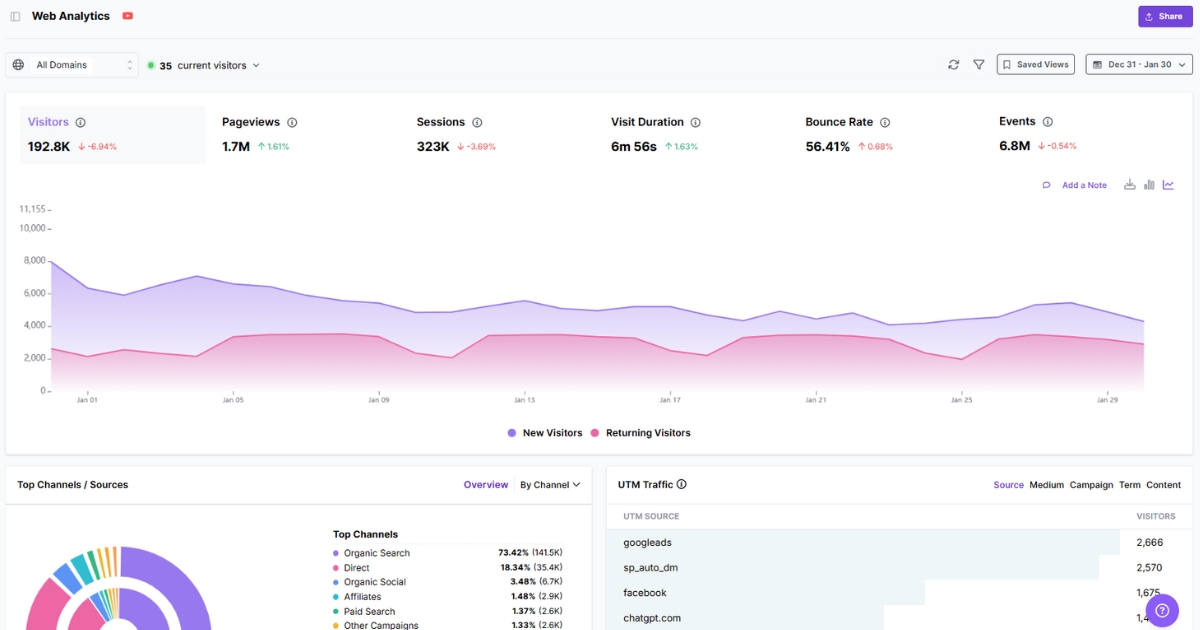
Usermaven stands apart by being incredibly easy to implement with minimal technical effort. There’s no need for developers to get started; simply add a single script to start tracking user interactions right away. Its intuitive design allows teams to quickly understand and act on insights, making it a great choice for those who want to skip the setup hassle and focus on results.
| Feature | Usermaven | Mixpanel | FullStory |
| Setup time | 5 minutes | Days | Hours |
| Technical expertise | None | High | Moderate |
| Event tracking | Automatic + real-time | Manual | Automatic |
| Implementation support | Premium | Basic | Premium |
| Maintenance needed | None to minimal | High | Moderate |
| Script performance | Lightweight | Moderate | Heavy |
Related: Pendo vs. FullStory vs. Usermaven
2. Attribution & marketing analytics
Mixpanel focuses on post-conversion analysis but lacks a comprehensive attribution model. While it offers powerful insights into user actions after conversion, marketing teams often need additional tools to track and understand the full customer journey across multiple touchpoints.
FullStory primarily concentrates on user experience, using session replays to visualize how users interact with your site. However, its marketing attribution capabilities are limited, providing only a partial view of which channels are driving conversions, which can leave gaps in understanding the complete customer journey.
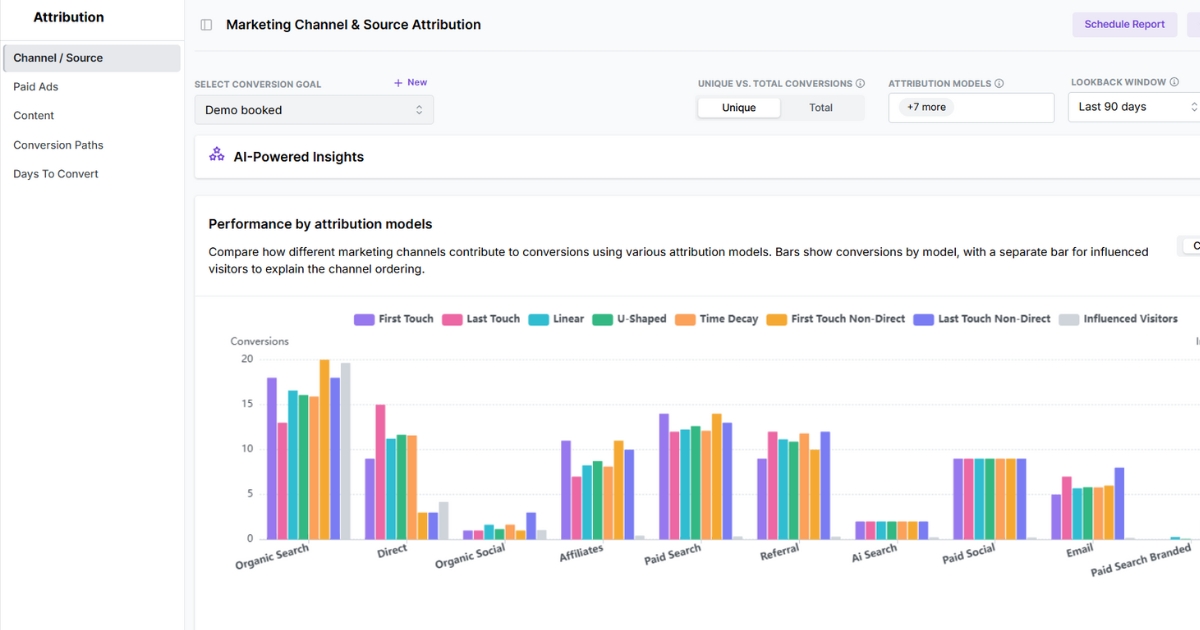
Usermaven provides a complete attribution solution with seven attribution models, including first-touch, last-touch, and multi-touch attribution. It features a 365-day attribution window, allowing teams to analyze long-term customer behavior. With AI-powered insights, Usermaven automatically identifies top-performing marketing channels, while its spend-period attribution and look-ahead feature help optimize marketing efforts and predict future trends using real-time data.
| Feature | Usermaven | Mixpanel | FullStory |
| Attribution models | 7 models | Basic | None |
| Campaign tracking | Advanced | Basic | Limited |
| Channel insights | AI-powered | Manual | Basic |
| Spend-period attribution + lookahead feature | Available | Not available | Not available |
| Marketing reports | Comprehensive | Basic | Limited |
For a broader perspective, check out Cometly alternatives to see how other tools stack up in terms of features and pricing.
3. Product analytics & user insights
Mixpanel excels in behavioral analytics with powerful retention and funnel analysis, but demands significant setup work. While you can create detailed engagement tracking and user segments, each funnel step and retention cohort requires manual configuration and ongoing maintenance by your engineering team.
FullStory captures user sessions in detail but lacks robust quantitative tools for engagement analysis. Their session replay helps visualize user flows, but measuring key metrics such as retention rates, funnel conversions, and feature adoption requires integrating with additional analytics platforms.
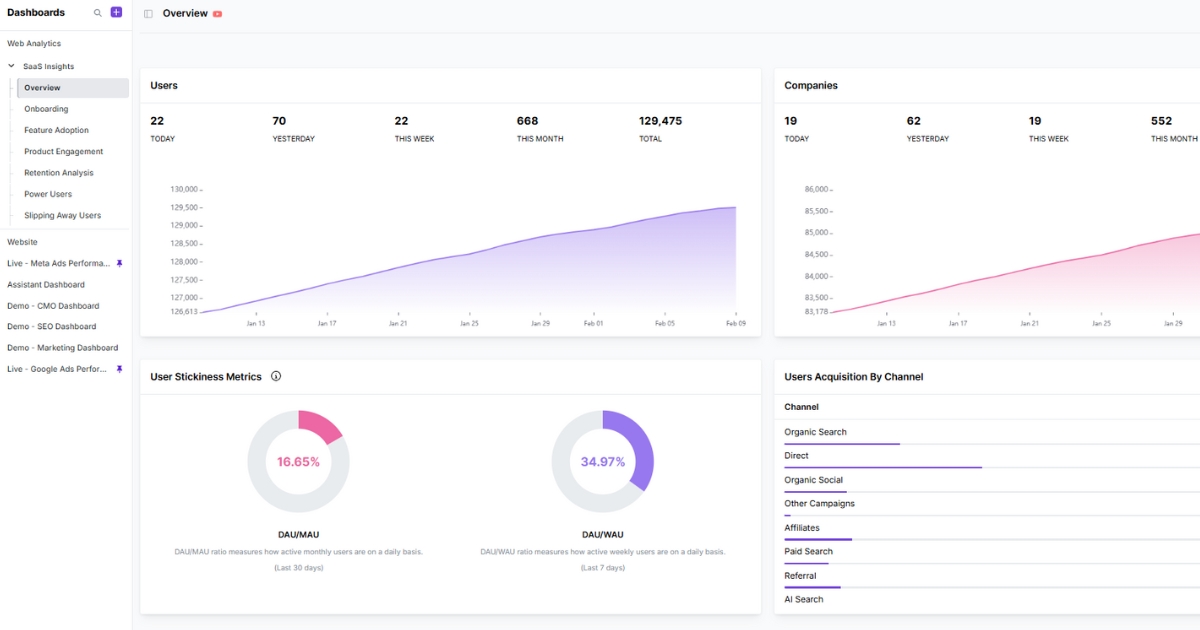
Usermaven delivers comprehensive product insights through automated tracking. Its AI automatically identifies engagement patterns, analyzes funnel performance, and tracks cohort retention without manual setup. From measuring feature adoption to understanding drop-off rate, teams get actionable insights without technical complexity.
| Feature | Usermaven | Mixpanel | FullStory |
| Feature adoption | Advanced | Basic | Basic |
| Segmentation | Advanced | Advanced | Basic |
| Engagement metrics | Comprehensive | Advanced | Basic |
| Retention analysis | Advanced | Advanced | Limited |
| Funnel analysis | AI-powered | Manual | Basic |
| Cohort tracking | Automatic | Manual | Limited |
| Drop-off analysis | Real-time | Delayed | Basic |
4. AI-powered analytics
Mixpanel offers Spark, an AI-powered tool that lets users generate reports by simply asking natural language questions. While this feature makes it easier for teams to access insights, Spark’s usage is limited to a monthly query cap. Teams that rely heavily on AI-driven reports may quickly hit this ceiling, limiting their effectiveness for more complex or frequent queries.
FullStory includes StoryAI, a feature designed to offer automated insights by analyzing user behavior and session data. However, access to StoryAI is available only on higher-tier plans, meaning smaller teams or those with budget constraints may not be able to fully leverage this AI tool. While it can help uncover patterns, AI capabilities are somewhat limited compared to those of more advanced analytics platforms.
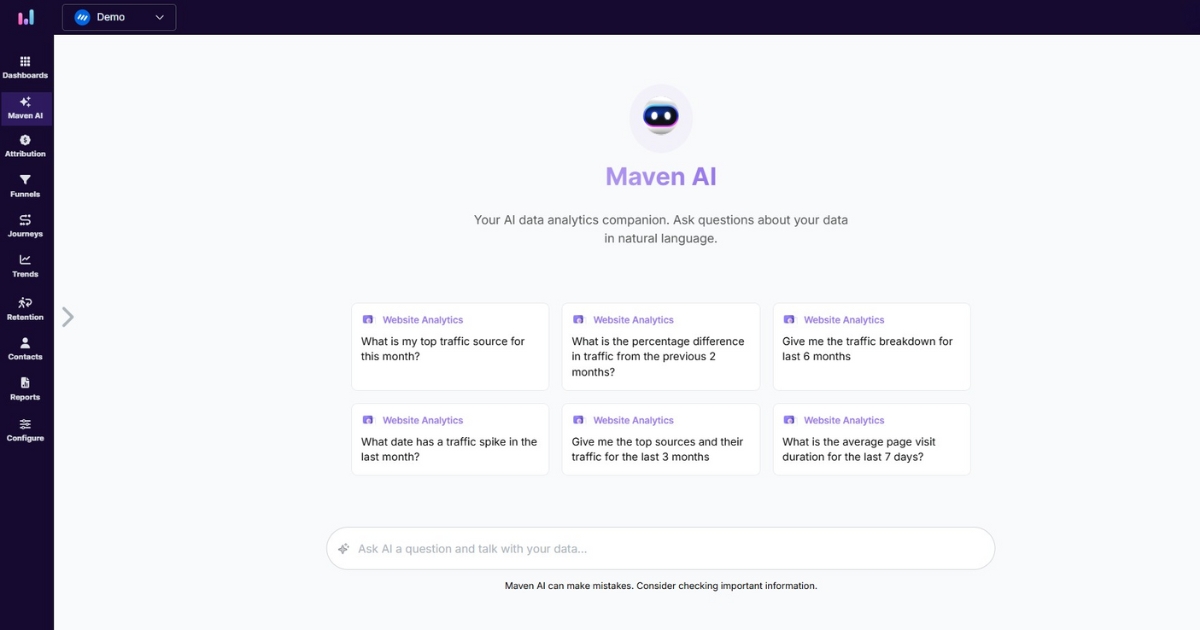
Usermaven’s Maven AI takes analytics a step further by providing real-time insights across the entire user journey. With features such as automated multi-touch attribution and predictive analytics, Maven AI helps teams optimize marketing efforts and uncover patterns in user behavior. It continuously generates actionable recommendations, making it an intuitive and powerful tool for teams looking to make informed decisions.
If you’re looking for a different approach to your analytics setup, exploring GA4 alternatives might provide the right fit for your needs.
| Feature | Usermaven | Mixpanel | FullStory |
| AI funnel insights | Advanced | Manual | Basic |
| Funnel suggestions | ✅ | None | None |
| Intelligent attribution | AI-powered | Manual | None |
| Automated trend detection | Advanced | Basic | Limited |
| AI journey mapping | ✅ | Manual | Basic |
5. Pricing & value
Mixpanel pricing scales with event volume, starting free for up to 1 million events. Beyond that, costs increase based on usage. While the Mixpanel pricing calculator can help estimate costs, the model can become unpredictable for growing teams, making it less ideal for those seeking consistent pricing.
FullStory offers a free plan with 30,000 sessions per month and 12 months of data retention. For more sessions or advanced features like session replays or StoryAI, you must upgrade to a paid plan. Overall, FullStory pricing for 2026 isn’t publicly available, requiring you to request a demo or custom quote. While the free plan is helpful for small teams, the lack of pricing transparency and data retention limits may not suit businesses seeking scalable options.
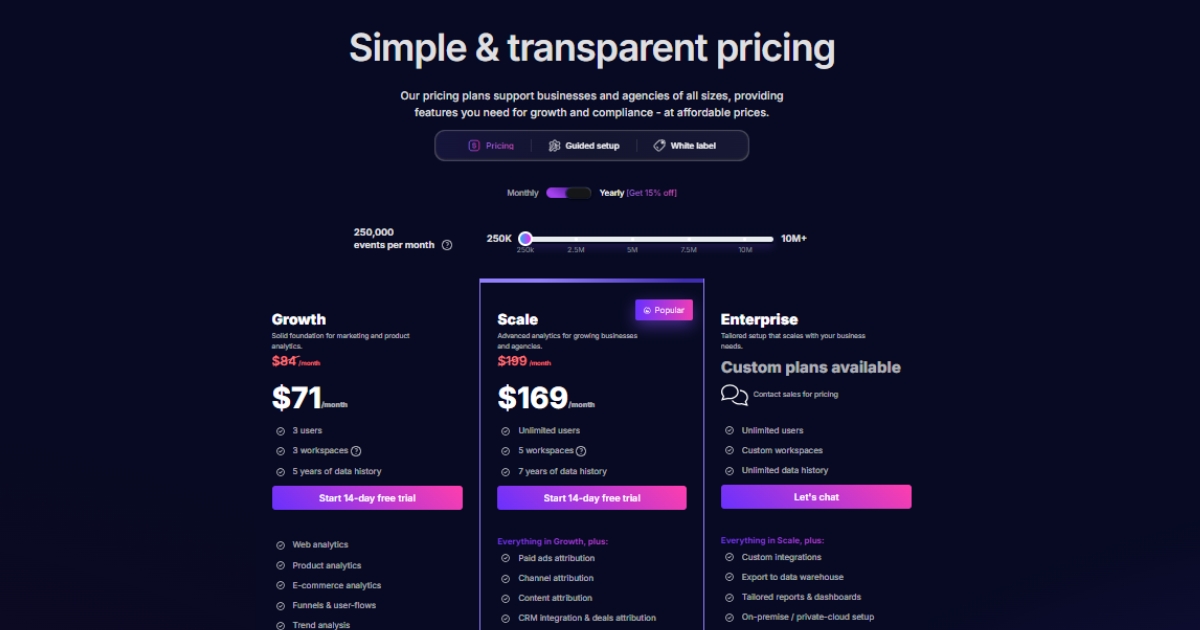
Usermaven offers clear and affordable pricing, starting at $84/month for the Growth plan. For teams with higher needs, the Scale plan is priced at $199/month and includes unlimited users and advanced analytics features. You can also enjoy 15% off with yearly billing, making it an even better value. With the added white label feature, you can fully customize the platform to reflect your brand. Additionally, Usermaven offers a $499 guided setup add-on to ensure a smooth, expertly supported implementation process.
Want to see how Usermaven compares to other tools? Dive into our blog on Heap vs. Mixpanel vs. Usermaven for a side-by-side breakdown.
| Feature | Usermaven | Mixpanel | FullStory |
| Hidden costs | None | Yes | Yes |
| Feature access | Mostly included | Limited | Limited |
| Free trial | 14 days | Not available | Not available |
| Price scaling | Predictable | Variable | Enterprise |
Making your decision
Consider these key factors when deciding on which platform you’d like to choose.
Budget constraints:
- Usermaven offers comprehensive features at startup-friendly prices
- Mixpanel’s user-based pricing gets expensive with growth
- FullStory requires significant enterprise investment
Technical resources:
- Usermaven needs minimal technical expertise
- Mixpanel demands significant engineering time
- FullStory requires a moderate technical setup
Primary needs:
- For complete analytics: Choose Usermaven
- For behavioral analysis only: Consider Mixpanel
- For session replay focus: Look at FullStory
Wrapping up
When choosing an analytics tool, it’s important to prioritize simplicity alongside powerful features. While Mixpanel and FullStory offer robust solutions, their complexity and unpredictable pricing can create hurdles as your business scales.
Usermaven stands out as a powerful website analytics tool that delivers comprehensive insights with minimal setup. It streamlines tracking, reporting, and attribution, allowing your team to quickly act on data without the technical overhead.
Ready to experience the simplicity and power of Usermaven? Start a free trial or book a demo, and let’s explore how it can transform your analytics and help drive better results.
FAQs
1. Is Usermaven better than Mixpanel?
It depends on your needs. Usermaven is better for teams wanting quick setup and comprehensive analytics without technical complexity, while Mixpanel suits teams with technical resources who focus primarily on behavioral analytics.
2. How much does FullStory cost compared to alternatives?
FullStory pricing ranges from $247-850/month targeting enterprises, while alternatives like Usermaven start at $84/month. Costs vary based on usage and features needed.
3. What’s the best analytics tool for startups?
For startups, look for tools like Usermaven with easy implementation, predictable pricing, and comprehensive features. Compare setup requirements, pricing models, and essential features like attribution and user tracking to match your needs.
4. Do I need developers to set up analytics tools?
It varies. Some tools, like Mixpanel, require significant developer resources for setup and maintenance, while others, like Usermaven, offer simple installation with a single script. Consider your technical resources when choosing.
5. Can I try analytics tools before buying?
Yes, most analytics platforms offer free trials: Usermaven (30 days) and FullStory (14 days). Use trials to test features and compatibility with your needs.
6. Which analytics tool has the best marketing attribution?
Look for tools offering multiple attribution models, like Usermaven, which offers seven, campaign tracking, and channel insights. Compare features like model flexibility, reporting capabilities, and integration options to match your marketing needs.
Leave a Reply