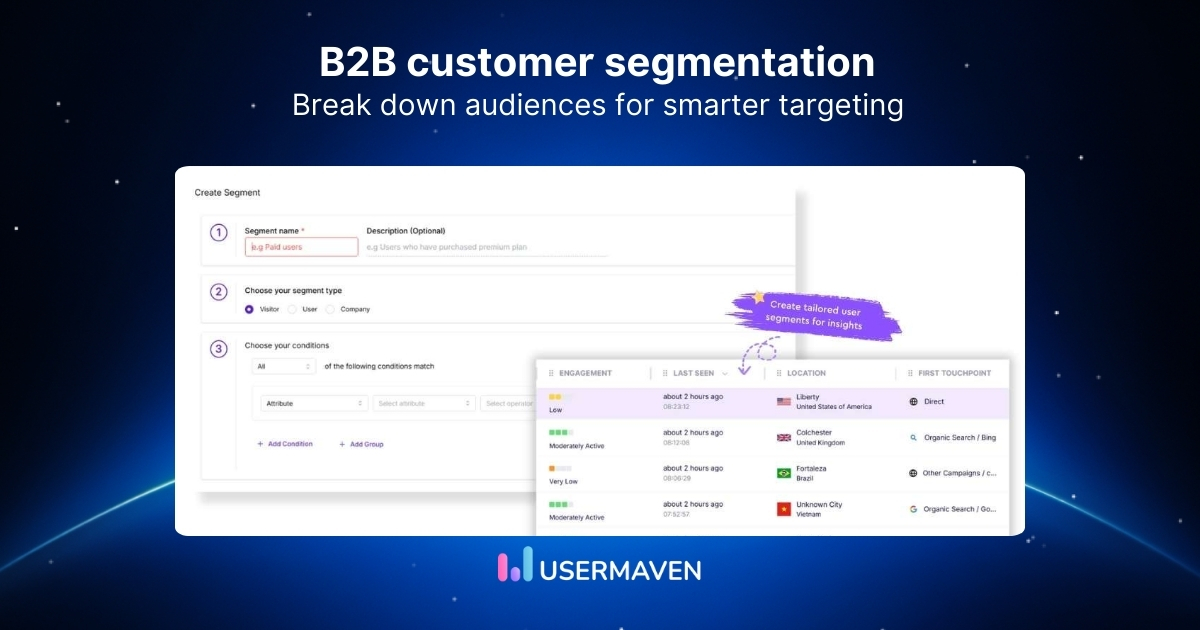
Imagine walking into a room full of business leaders from different industries, sizes, and goals. Then imagine giving them all the exact same pitch. It would never work. Yet many B2B companies still treat their entire audience as one group.
B2B customer segmentation changes that.
It helps you understand the differences between your customers so you can reach them with the right message and the right product experience. When you know how to group customers based on real business factors, you can improve conversions, reduce churn, and build more meaningful relationships.
Let’s look into B2B customer segmentation in detail and break down what it really means for your marketing, sales, and customer experience. Along the way, you will see the key models, actionable approaches, and practical structures that help turn segmentation from a concept into a measurable growth lever.
What is B2B customer segmentation?
B2B customer segmentation is the process of grouping business customers based on the characteristics they share. Instead of focusing on personal details like age or lifestyle, it looks at business-level traits. These may include company size, industry, purchasing behavior, product usage, revenue potential, or specific needs.
This same logic shapes SaaS customer segmentation, where user groups are created based on how they adopt features, engage with the product, and progress through the customer lifecycle.
The idea is straightforward. You want to understand what sets one group of companies apart from another so you can communicate with them in a way that feels relevant. When segmentation is done well, it improves targeting, boosts engagement, and helps increase conversion rates. It also makes it easier to shape your product experience around what different customers actually need.
Importance of B2B customer segmentation
Segmentation is essential in B2B because buyers expect personalized communication, sales cycles are complex, and one message cannot fit every customer group.
- It improves targeting and relevance
You can speak to each group’s real priorities instead of sending generic messages.
- It increases sales efficiency
Sales teams know which accounts to focus on and where to spend their time.
- It boosts customer retention
You can spot at-risk customers earlier and support them in ways that match their needs.
- It helps allocate resources wisely
Your marketing, sales, and support efforts go to the groups that deliver the highest impact.
- It guides better product decisions
You get clearer insight into what each customer group expects from your product.
- It builds stronger relationships
When customers feel understood, trust grows, and the partnership lasts longer.
Target the right audience
with Usermaven Segments
*No credit card required
How B2B customer segmentation differs from B2C segmentation
Although both aim to group customers effectively, segmentation in B2B differs significantly from B2C. Businesses make decisions in a more complex and structured way than individual consumers.
In B2C, companies often use demographic, psychographic, geographic, and behavioral segmentation to understand individual buyers. In B2B, segmentation focuses on business-level factors because purchasing decisions involve entire organizations rather than individuals.
| Aspect | B2B segmentation | B2C segmentation |
| Decision making | Involves multiple stakeholders such as managers, technical evaluators, finance, and executives. | Usually involves a single individual making a personal choice. |
| Sales cycle | Longer evaluation process that includes pricing reviews, testing, and ROI analysis. | Shorter buying journey driven by convenience, preference, or impulse. |
| Purchase motivation | Focuses on efficiency, cost savings, scalability, and long-term value. | Often influenced by emotions, brand preferences, and personal needs. |
| Audience size | Smaller and more defined customer base. | Much larger and broader consumer audience. |
| Relationship length | Built for long-term engagement with ongoing support. | Often transactional with shorter relationship cycles. |
B2B customer segmentation models
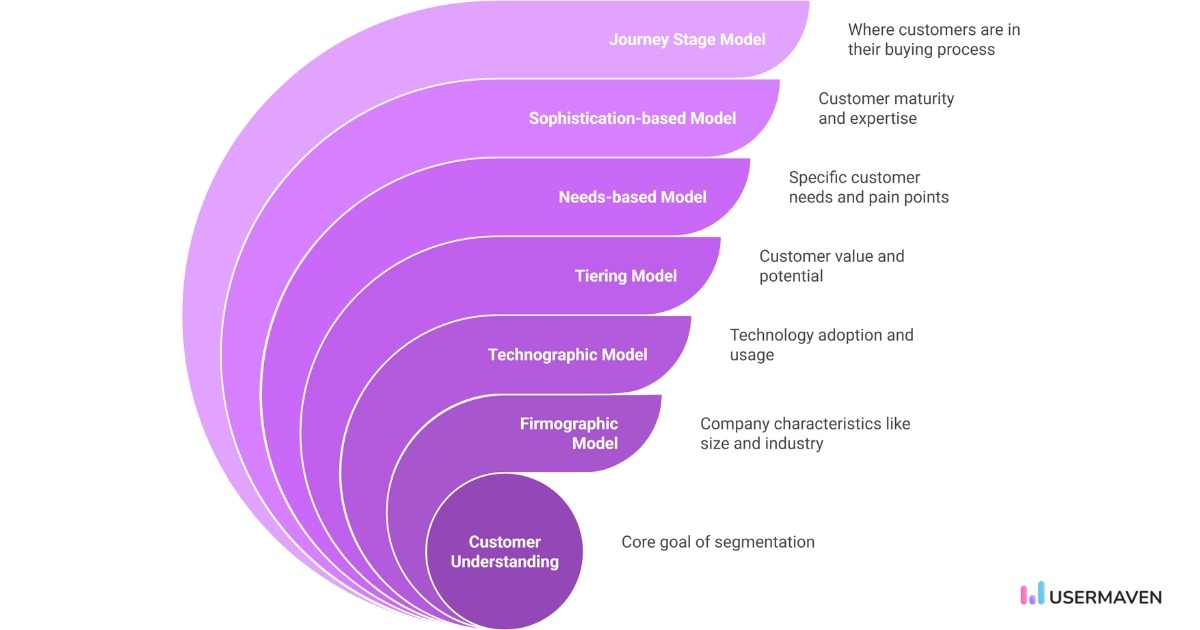
Segmentation models help you group customers in meaningful ways so you can understand their needs, behaviors, and potential. Each model offers a different perspective, and most companies use a combination of several models to get a full picture of their customers.
Below are the most useful B2B segmentation models and how they work.
1. Firmographic model
The firmographic model segments customers based on basic business characteristics. These are high level details that define who the customer is as a company.
Common firmographic factors include company size, industry, revenue, location, and number of employees.
Example:
A marketing analytics platform may split customers into:
- Startups with fewer than 20 employees
- Mid sized companies with 20 to 200 employees
- Enterprises that operate in multiple locations
This helps teams adjust pricing, messaging, and onboarding based on company scale. Tools like Usermaven can automatically enrich accounts with firmographic data to keep segments updated.
2. Technographic model
The technographic model groups customers based on the tools and technologies they use. This is especially important when your product must integrate with other systems or when buying decisions depend on tech compatibility.
Technographic data may include CRM platforms, analytics tools, cloud providers, CMS systems, or marketing automation software.
Example:
A workflow automation tool might segment customers into:
- Companies using HubSpot as their CRM
- Companies using Salesforce
- Companies using custom in house systems
These groups will need different onboarding flows and integration guidance. Platforms like Usermaven can identify technology sources based on visitor activity and product usage.
3. Tiering model
The tiering model focuses on customer value and revenue potential. It groups customers into layers, which helps teams prioritize where to invest their time and effort.
Common tiers include high value, mid value, and low value segments.
Example:
A SaaS company may place customers into:
- Tier 1 accounts with high lifetime value and strong expansion potential
- Tier 2 accounts with steady but moderate usage
- Tier 3 accounts with low usage or lower revenue contribution
Tier 1 accounts may receive dedicated success managers, while tier 3 accounts may receive automated onboarding. Segmentation tools make it easier to assign value based on usage, contract size, and engagement.
4. Needs-based model
The needs-based model groups customers based on their goals, challenges, and motivations. This goes beyond surface-level traits and looks at what customers are trying to achieve.
This model is often identified through customer interviews, surveys, and behavior analysis.
Example:
A customer support platform may segment businesses into:
- Companies that want faster response times
- Companies that want to reduce ticket volume
- Companies that want advanced automation
Each of these groups would require different product messaging and onboarding recommendations.
5. Sophistication-based model
The sophistication model segments customers based on their level of maturity in your product area. It focuses on how advanced the customer is in terms of processes, strategy, or product adoption.
This model helps teams support customers based on where they are in their journey, not just who they are.
Example:
A product analytics tool might classify customers as:
- Beginner: new to analytics and exploring basic dashboards
- Intermediate: using reports to make decisions
- Advanced: running cohort analysis, funnels, and custom events
Usermaven, for example, can help identify these groups by monitoring feature adoption and understanding how often users engage with key parts of the product.
6. Journey stage model
The journey stage model segments customers based on where they are in the buying or adoption process. This helps teams deliver the right communication at the right moment.
Stages may include awareness, consideration, evaluation, onboarding, adoption, and expansion.
Example:
A CRM tool may split accounts into:
- Prospects learning about CRM benefits
- Leads comparing different vendors
- New customers completing onboarding
- Active customers using advanced features
- Long-term customers are ready for expansion
Each stage requires different messaging and support. Understanding journey stages ensures customers receive timely, relevant guidance.
How to do B2B customer segmentation step by step
Many companies struggle with segmentation because they are not sure how to get started. Below is a proven five-step process you can follow.

Step 1. Define your segmentation goals
Before collecting any data, you need clarity on what you want to achieve. Some examples of segmentation goals include:
- Improve lead quality
- Enhance personalization
- Reduce churn
- Prioritize high-value accounts
- Improve onboarding
- Support account-based marketing
Then identify the KPIs that will help you measure success. These may include customer lifetime value, conversion rates, churn rate, or activation metrics.
Step 2. Collect and analyze your customer data
Segmentation requires clean and reliable data. Use both internal and external sources, including CRM data, product analytics, surveys, interviews, and industry databases. Make sure to remove duplicate entries, correct missing data, and verify accuracy.
Step 3. Build and validate your segments
Once you have your data, choose your segmentation criteria and start applying advanced customer segmentation techniques to group customers more accurately. Combine multiple variables such as industry, company size, product usage, and goals to create segments that reflect real behavior and needs.
Test whether each segment is large enough, distinct enough, and actionable. You may need to refine your segments based on feedback from your sales and customer success teams to ensure they are practical and aligned with real customer patterns.
Step 4. Apply segmentation across your operations
Segmentation is not useful unless you put it into action. Here is how to use it:
- Marketing can personalize messaging and content
- Sales can prioritize high-value accounts
- Customer success can tailor onboarding
- Product teams can build features based on segment needs
Step 5. Monitor and optimize your segments
Business needs change over time. Review your segments regularly. Look for signs such as declining engagement or inconsistent performance. Update your segments when necessary to ensure they remain relevant and useful.
B2B segmentation variables and criteria
To build strong segments, you need to choose the right criteria. Here are the most common variables used by B2B companies.
Firmographic variables
- Company size
- Revenue
- Industry
- Location
- Number of employees
- Growth stage
Behavioral variables
- Frequency of product usage
- Feature adoption
- Engagement with marketing content
- Purchase history
- Contract renewal behavior
Technographic variables
- CRM systems
- Analytics tools
- Marketing platforms
- Operating systems
- Cloud providers
Needs-based variables
- Key challenges
- Desired outcomes
- Budget limitations
- Urgency
- Support expectations
Value-based variables
- Customer lifetime value
- Average order value
- Upsell potential
- Cost to support
Target the right audience
with Usermaven Segments
*No credit card required
B2B market segmentation examples
Real life examples help show how segmentation works and how it supports better decisions. Below are three stronger, more practical examples that use different segmentation models and explain why these segments matter.
Example 1: SaaS analytics platform (behavioral segmentation)
A SaaS analytics tool might group customers based on how they use the product.
Segments may include:
- New users exploring basic dashboards
They need onboarding tutorials and simple templates. - Teams tracking core KPIs regularly
They need automation features and alerts. - Power users running cohorts, funnels, and custom events
They need advanced training and premium support.
Why this works:
Behavioral segmentation helps the company personalize onboarding, improve feature adoption, and identify expansion opportunities. Platforms like Usermaven make this model easier by highlighting which features each customer uses most.
Example 2: Manufacturing equipment supplier (needs-based segmentation)
A B2B manufacturer might segment customers based on the specific outcome they want, not their size.
Segments may include:
- Factories aiming to reduce downtime
They need reliable machines and quick maintenance support. - Companies trying to scale production
They need modular equipment and upgrade options. - Businesses focused on cost reduction
They need entry-level options and flexible financing.
Why this works:
Needs-based segmentation helps the sales team align recommendations with what each customer is trying to achieve, which increases trust and conversion rates.
Example 3: Logistics and supply chain software (journey stage segmentation)
A logistics platform could segment customers by where they are in the buying or adoption process.
Segments may include:
- Prospects comparing tracking solutions
They need educational content and ROI examples. - New customers integrating the software
They need implementation support and training. - Active customers optimizing workflows
They need advanced analytics and automation features. - Long term customers exploring expansion
They need multi-warehouse tracking and volume discounts.
Why this works:
Journey stage segmentation allows the company to deliver the right messaging and support at the right time, improving both adoption and retention.
B2B market segmentation best practices
Good segmentation is not just about grouping customers. It is about making sure those groups actually help you reach the right accounts, personalize your message, and make better decisions.
A good market segmentation analysis plays an important role here as it helps you evaluate whether your segments are useful and aligned with real customer behavior.
Here are the best practices that help companies get measurable results from segmentation.
- Build segments based on real data, not assumptions
Start with customer data you can trust, such as product usage, firmographics, and engagement patterns. This helps you avoid guessing who your best customers are and creates segments that reflect real behavior.
- Keep your segments focused and manageable
Too many segments make it hard for teams to stay aligned. Aim for a small number of meaningful groups that your marketing, sales, and customer success teams can realistically act on.
- Make sure each segment is truly actionable
A good segment should guide what message to send, which channels to use, and how your team should engage. If you cannot change your strategy based on a segment, it is not useful.
- Use more than one segmentation method
No single model gives a full picture of your customers. Combine firmographic, behavioral, technographic, and needs-based insights to create segments that feel accurate and well-rounded.
- Validate your segments with real customers and internal teams
Share your segments with sales, marketing, and customer success to confirm they match what these teams see in the field. This helps refine your groups and ensures company-wide alignment.
- Refresh your segmentation regularly
Businesses evolve. New features launch. Markets shift. Your segments should reflect those changes. Review them at least twice a year to stay aligned with customer needs.
Challenges in B2B customer segmentation
Segmenting customers is not always easy. Here are common challenges and how to solve them.
- Poor data quality: Missing or inconsistent data can lead to incorrect segments. Regular data cleaning helps solve this problem.
- Over segmentation: Creating too many segments makes it hard to manage and prioritize. Focus on the ones that matter most.
- Stakeholder resistance: Some teams may be hesitant to adopt segmentation. Educating them on its benefits helps build support.
- Static segmentation: Customer needs change over time. Segments must be updated regularly to remain useful.
- Lack of clear goals: If you do not define what you want to achieve, segmentation becomes unclear. Start with clear objectives.
The role of Usermaven in B2B customer segmentation
Effective B2B customer segmentation relies on accurate data and real-time insights. Usermaven empowers businesses with advanced digital analytics to track customer behavior, identify key segmentation variables, and refine their targeting strategies. By using Usermaven’s AI-driven insights and real-time event tracking, companies can create precise, actionable segments that enhance marketing effectiveness.
Here’s how Usermaven helps businesses segment and target B2B customers more effectively:
1. Identifying key segmentation variables
Usermaven provides deep insights into customer interactions, helping businesses analyze critical segmentation factors like company size, industry, purchase behavior, and technology usage. With advanced filtering and real-time data tracking, you can pinpoint the most relevant variables for defining your segments.
2. Enabling data-driven decision-making
Instead of relying on assumptions, Usermaven offers a factual foundation for segmentation decisions. By analyzing historical and real-time customer data, businesses can segment audiences based on actual behavior, ensuring targeted and impactful marketing strategies.
3. Improving personalization and targeting
Usermaven’s AI-powered insights reveal customer behavior patterns, allowing businesses to create hyper-targeted campaigns. Whether segmenting is based on firmographics or engagement trends, Usermaven ensures your messaging aligns with each segment’s unique needs, driving higher conversion rates.
4. Continuous optimization and refinement
Customer segmentation is an ongoing process. Usermaven enables businesses to monitor segment performance, track behavioral shifts, and refine strategies in real time. With continuous optimization, businesses stay ahead of market changes and adapt their segmentation for better results.
By integrating Usermaven into your B2B segmentation strategy, you gain the tools to make smarter, data-driven decisions that enhance targeting, improve personalization, and drive business growth.
To wrap it up,
B2B customer segmentation helps you understand your customers, personalize your approach, and make smarter decisions across the entire customer journey. When your segments are clear and data-driven, every part of your business benefits.
If you want an easy way to build accurate segments and keep them updated in real time, the best website analytics tool for the job is Usermaven. It gives you the insights you need to target better, convert more, and create product experiences your customers will love.Start your free trial today or reach out to our team to see how Usermaven can support your growth.
Target the right audience
with Usermaven Segments
*No credit card required
FAQs
1. How does B2B customer segmentation work?
It works by grouping customers based on shared characteristics. These characteristics may include company size, industry, product usage, or specific needs. Each group is then targeted with personalized messaging, support, and product experiences.
2. What is the target audience in B2B?
The audience includes organizations that match your ideal customer profile. These businesses have the right size, industry, needs, and budget for your product.
3. What is the 95 to 5 rule in B2B marketing?
This rule states that only 5 percent of your potential customers are ready to buy at any time. The remaining 95 percent are not currently in the market. This highlights the need for long-term brand building and nurturing.
4. What are the 4 Ps of B2B marketing?
The four Ps are product, price, place, and promotion. These elements shape how companies communicate value.
5. What role does AI play in modern B2B customer segmentation?
AI enhances B2B customer segmentation by automating data analysis, identifying hidden patterns, and enabling dynamic, real-time segmentation updates. AI-driven tools, like Usermaven, allow businesses to track user behavior automatically, ensuring segmentation remains accurate and actionable without manual intervention.
6. How does proper segmentation improve customer onboarding?
Proper segmentation improves customer onboarding by allowing businesses to tailor onboarding experiences based on segment-specific needs. By understanding a customer’s industry, size, and behavior, companies can provide relevant resources, personalized training, and proactive support that accelerate adoption and long-term satisfaction.
7. Can B2B segmentation help identify cross-sell and upsell opportunities?
Yes, B2B segmentation helps identify cross-sell and upsell opportunities by analyzing customer usage patterns, purchase history, and business needs. By grouping customers based on behavior, companies can recommend complementary products or services that align with their existing needs.
Leave a Reply