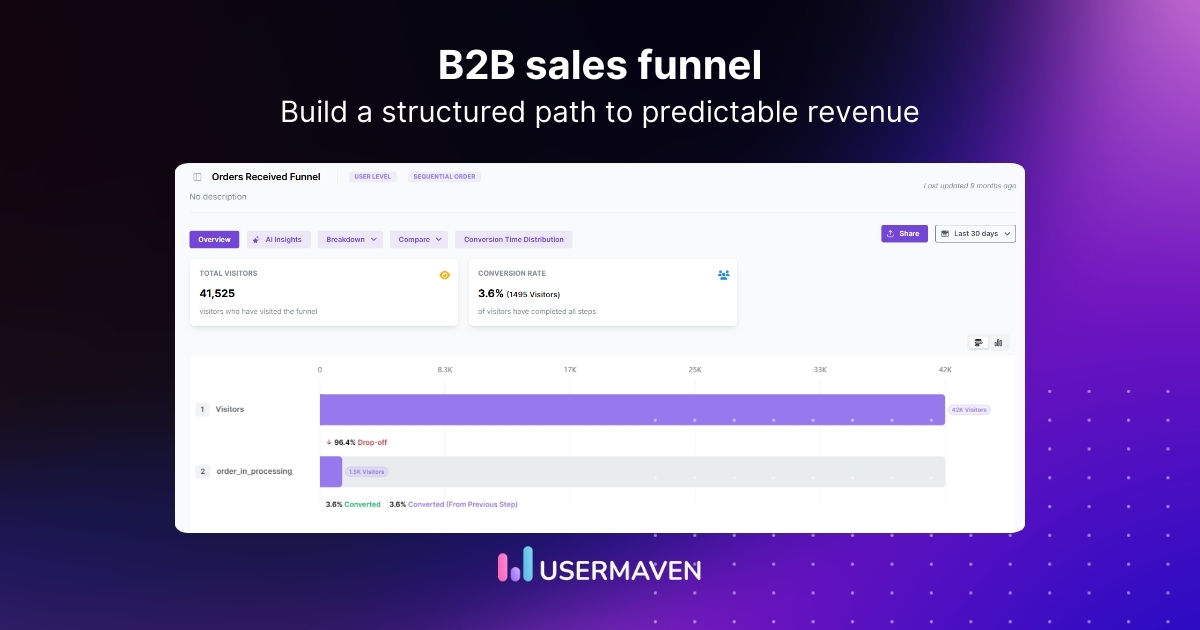
What if you could look at your sales process and instantly see where leads drop off, what motivates them, and what it takes to close deals faster?
That is exactly what a strong B2B sales funnel helps you do.
It turns random interactions into a predictable system that guides buyers from their first touchpoint all the way to purchase.
If you are trying to learn how to create a B2B sales funnel that improves lead quality and boosts conversions, you are in the right place. This guide breaks everything down in a clear way. You will learn what a B2B funnel is, the stages involved, the key metrics, and every step you need to build a high-performing funnel of your own.
Let’s begin.
Turn visitors into paying
customers with funnel analysis
*No credit card required
What is a B2B sales funnel?
A B2B sales funnel is a clear path that shows how business buyers move from discovering your brand to becoming paying customers. It breaks the buyer journey into simple stages so you can understand what buyers need at each point and guide them with the right content, conversations, and value.
Think of it as a roadmap. It helps you attract the right companies, highlight their challenges, introduce your solution, and support them until they feel ready to buy. With an automated sales funnel handling key steps like nurturing and follow-ups, the entire journey becomes consistent and easier to manage. A well-structured funnel keeps your team organized and creates a smoother experience for every potential customer.
B2B vs. B2C sales funnel: What’s the difference?
A B2B funnel is just one of the many types of sales funnel used in marketing and sales. Below is a quick comparison of how B2B and B2C funnels work at each stage of the buying journey.
| Category | B2B sales funnel | B2C sales funnel |
| Decision-making process | Multiple stakeholders such as managers, technical teams, and executives | A single individual makes the decision |
| Buying timeline | Longer cycles with detailed evaluations and internal approvals | Shorter cycles with faster purchases |
| Customization | Requires tailored proposals, custom pricing, and onboarding | Products are simple and standardized |
| Content needed | Relies on webinars, case studies, comparisons, and ROI-focused content | Driven by visuals, reviews, social proof, and product pages |
A structured sales funnel helps manage these differences and supports buyers throughout a longer and more detailed journey.
Why are B2B sales cycles longer?
B2B sales cycles take longer due to several factors that are not usually present in B2C purchasing.
- More decision-makers: Multiple people must approve the purchase. This increases meetings, internal discussions, and review time.
- Higher financial risk: B2B purchases are high-ticket investments. Buyers take more time to ensure they are choosing the right vendor.
- Detailed evaluation: Buyers need to see demos, documentation, case studies, technical details, security certification, and pricing structures.
- Internal approvals: Legal, procurement, and leadership teams often require formal review.
- Need for personalization: Most B2B purchases require custom onboarding, implementation guidance, or tailored features.
A well-built B2B sales funnel helps manage this lengthy process by offering the right information at the right time, removing friction, and giving buyers what they need to feel confident.
Stages of a B2B sales funnel
A B2B sales funnel is built around six clear stages that show how buyers move from first discovering a problem to eventually becoming customers. These stages give you a complete view of the entire journey and help you understand what buyers need at every point, from awareness to purchase.
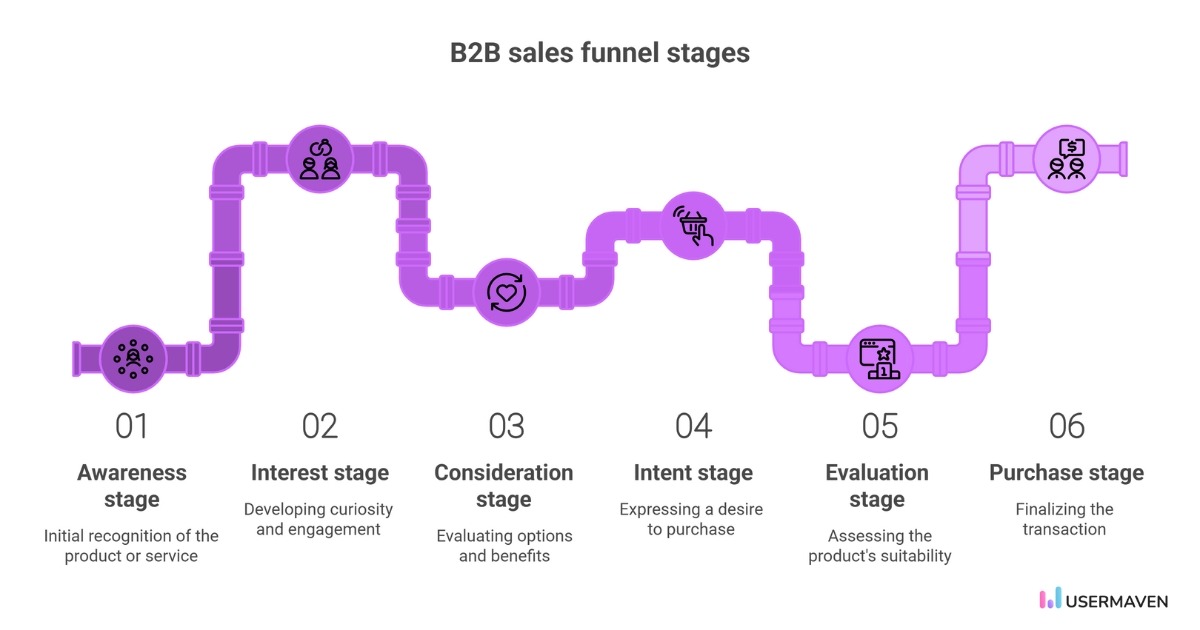
Let’s look at each of these six stages in detail and see how they guide buyers through the journey.
Stage 1. Awareness stage
In the awareness stage, people discover they have a problem and start looking for information. They are not ready to buy yet. They just want to understand what is happening and explore possible solutions.
Examples of awareness-stage content
- Blog posts that explain a challenge
- How-to articles
- Industry trends
- SEO pages about common problems
- Short videos or infographics
- LinkedIn posts
- Webinars or podcasts that give broad insights
Example
A project management software company publishes a blog post on “why teams miss deadlines without a central workflow system.” Someone finds it through a search, reads it, and becomes aware of the underlying problem.
Goal at this stage
Attract web visitors and educate them. You are not selling. You are building trust.
Stage 2. Interest stage
In the interest stage, prospects begin exploring your brand because something you shared resonated with their problem. They become interested in understanding how you can help.
Interest-stage content examples
- Introductory guides
- Industry reports
- Email newsletters
- Light comparison content
- Social content that explains your point of view
Example
After reading the blog post, the visitor downloads a free guide on “how to structure team workflows” and signs up for your newsletter. This signals growing interest.
Goal at this stage
Help them explore their challenge more deeply and see you as a reliable source of expertise.
Stage 3. Consideration stage
At this stage, buyers are aware of their needs and are evaluating potential solutions. They are comparing vendors and want to see clear value.
Consideration-stage content examples
- Case studies showing real results
- Product demos
- Feature comparisons
- Testimonials
- Product webinars
- Limited free trials
- In-depth email nurturing sequences
Example
The subscriber attends a webinar where you walk through common workflow bottlenecks and show how your software solves them. They also explore your case studies.
Goal at this stage
Show prospects why your solution works, how it solves their problem, and why you are different from alternatives.
Stage 4. Intent stage
In the intent stage, buyers show clear signs that they are interested in buying. They may request pricing, ask detailed questions, or bring more team members into the conversation.
Intent-stage content examples
- Pricing explanations
- ROI guides
- Technical documentation
- Competitor comparison pages
- Customer references
Example
The prospect fills out a demo request form and asks for pricing. They may also bring a colleague to the call or ask for a comparison with a competitor they are considering.
Goal at this stage
Confirm that your solution is the right choice and address remaining objections.
Stage 5. Evaluation stage
During evaluation, prospects review final details such as contract terms, onboarding, integrations, or security. The deal is close, but the buyer needs reassurance.
Evaluation-stage examples
- Security documents
- Implementation plans
- Proposal walkthroughs
- One-on-one consultations
- Custom feature demonstrations
Example
Your team shares a proposed onboarding timeline, a short implementation overview video, and a tailored ROI estimate based on the prospect’s needs. This gives the buyer confidence.
Goal at this stage
Provide clarity and confidence so that decision-makers can finalize the choice.
Stage 6. Purchase stage
This is where prospects become customers. By the time they reach this point, they have already passed through your lead qualification process, so clarity, transparency, and smooth execution matter the most.
Purchase-stage examples
- Final proposals
- Agreements
- Onboarding schedules
- Welcome emails
- Access details
- Training materials
Example
The buyer signs the agreement, receives a welcome email, and gets access to an onboarding checklist that outlines the first steps for their team.
Goal at this stage
Deliver a smooth purchasing experience and set the relationship up for long-term success.
Post-purchase stage: Building retention and advocacy
Many businesses stop the funnel after the purchase, but long-term success comes from supporting customers after they become clients. Strong post-purchase activity increases retention, upgrades, and referrals.
1. Onboarding
Help customers understand how to use your product and achieve their first win quickly.
2. Customer support
Provide accessible support channels such as help centers, email support, and live chat.
3. Upselling and cross-selling
Share advanced features or relevant add-ons only after customers have seen value.
A good post-purchase process turns satisfied customers into advocates who recommend your solution to others.
Turn visitors into paying
customers with funnel analysis
*No credit card required
How to create a B2B sales funnel step-by-step
Now that we understand the stages, here is a simple step-by-step process to create a high-performing B2B sales funnel from scratch.
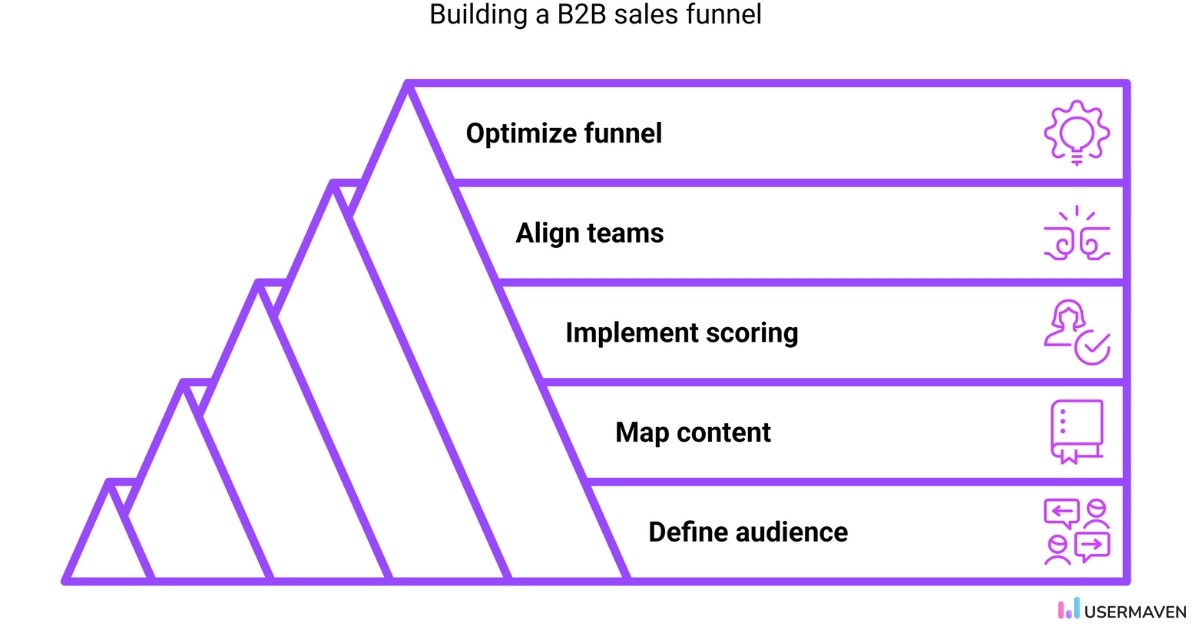
Step 1: Define your target audience and buyer personas
Understanding who you are selling to is the foundation of any B2B sales funnel. Begin by identifying:
- Industry
- Company size
- Job roles
- Pain points
- Goals
- Budget range
- Decision-making flow
Usermaven’s Contacts Hub helps analyze visitor behavior, common conversion paths, and engagement patterns, which makes it easier to build accurate personas based on real data.
Actionable tips
- Review data from website analytics, CRM, and customer interviews.
- Identify common challenges that prospects face.
- Create short persona descriptions that your sales and marketing teams can use.
Step 2: Map content to each stage of the funnel
Each stage needs content that answers the specific questions buyers have at that moment.
TOFU content ideas
- Blog posts
- Guides
- Social content
- SEO pages
- Infographics
MOFU content ideas
- Case studies
- Webinars
- Comparison pages
- Product walkthrough videos
BOFU content ideas
- Pricing pages
- Testimonials
- Proposals
- Consultations
Usermaven can help identify which content pieces perform best at each stage using attribution and engagement rate.
Step 3: Implement lead scoring and nurturing
Lead scoring helps separate high-quality leads from casual visitors. You can assign points based on actions such as:
- Webinar attendance
- Demo requests
- Multiple page visits
- Email engagement
- Trial signups
Once you understand lead quality, create nurturing workflows that send the right content automatically. This helps keep leads engaged until they are ready to talk to sales.
Step 4: Align your sales and marketing teams
Smooth alignment between teams prevents leads from falling through the cracks. To achieve this, create:
- Unified goals
Both teams should agree on what a qualified lead is and how it is handled.
- Shared insights
Use shared dashboards to monitor performance, common objections, and drop-off points.
- Regular communication
Schedule short meetings to review lead progress, discuss challenges, and update strategies.
Platforms like Usermaven support this alignment by giving both teams access to real-time funnel data.
Step 5: Use tools and technology to optimize the funnel
Successful B2B funnels rely on the right technology. Here are essential tools:
1. Analytics and tracking tools
Track user journeys, drop-off points, conversions, and content performance. Tools such as Usermaven can help.
2. CRM systems
Store lead information, track conversations, and manage follow-ups. Examples include HubSpot CRM or Salesforce.
3. Marketing automation
Automate nurturing emails, scoring, and lead routing. Tools such as ActiveCampaign or Marketo work well.
4. Content management systems
Publish blog posts, landing pages, and case studies. Examples include WordPress or Webflow.
5. Email marketing systems
Send relevant messages to segmented lists. Tools such as Mailchimp or Klaviyo are commonly used.
6. Lead qualification tools
Score leads based on demographic fit and engagement level. Platforms like Usermaven or HubSpot can support this.
User-friendly platforms such as Usermaven combine many of these capabilities into a single solution, making it easier to monitor performance and identify bottlenecks.
Also read: Drive better results with smart and powerful AI funnel insights
B2B sales funnel metrics you should track
To know whether your funnel is working, you need to track clear metrics. Here are the most important ones.
Measure how many leads move from one stage to the next.
- Sales funnel velocity
Calculate how fast leads move through the stages.
Compare the cost of sales and marketing to the number of customers acquired.
- Average deal size
Understand how much revenue each new customer generates.
- Win or loss ratios
Review how many deals close and why others fall through.
Estimate long-term revenue from a customer.
Usermaven’s multi-touch attribution makes it easier to see which channels and touchpoints lead to conversions. This helps you allocate resources effectively and improve weak stages.
How does Usermaven simplify funnel tracking and optimization?
Usermaven makes it easier to track, understand, and improve every stage of your B2B sales funnel. The platform brings all your funnel insights into one place so you can see how leads move, where they drop off, and which touchpoints drive conversions.
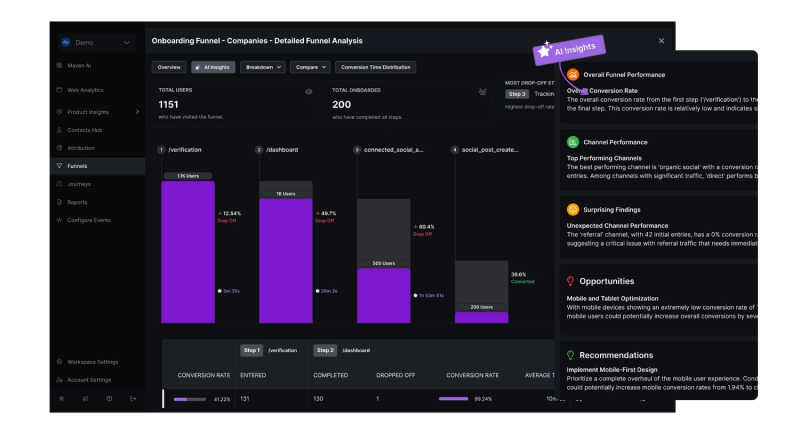
Here is how Usermaven helps you optimize your funnel more effectively.
1. No-code event tracking
Track key actions such as signups, demo requests, page views, and feature usage with no code analytics and event tracking. This makes it simple to monitor how leads interact with your product or website.
2. Real-time funnel reports
See how prospects move from awareness to purchase with clear visual funnels. You can instantly spot drop-off points, slow stages, and opportunities to improve the user journey.
3. Privacy-friendly analytics
Usermaven is built with privacy in mind, offering GDPR and CCPA-compliant tracking that respects user rights without sacrificing data quality. You get actionable analytics insights across the entire customer journey, making it ideal for B2B companies operating under strict compliance standards.
4. Advanced attribution models
Usermaven gives you clarity with attribution models such as first-touch, last-touch, linear, time-decay, and more. This helps you see which campaigns and content truly influence conversions so you can allocate budget more effectively.
5. Contact timelines and behavioral insights
Get a full picture of every lead’s journey. See which pages they viewed, which emails they opened, and which actions they took before converting.
6. Lead scoring support
Use engagement data to identify your highest-quality leads. This helps sales teams prioritize outreach and focus on prospects who are ready to move to the next stage.
7. Unified dashboards for all teams
Marketing and sales can view the same metrics, funnel performance, and user journeys. This removes guesswork and helps teams work together more efficiently.
Usermaven brings all these features together to make funnel analysis smoother and more actionable. It helps you understand what is working, what needs improvement, and how to create a more predictable and consistent flow of conversions from top to bottom.
Turn visitors into paying
customers with funnel analysis
*No credit card required
Common B2B sales funnel challenges and solutions
Notable obstacles can appear at every step of this process. Addressing them in advance can protect your funnel from leaks and inefficiencies.
1. Long sales cycles
B2B purchases often involve multiple layers of review and can take months.
- Improve lead nurturing: Send valuable content and check in about business needs at regular intervals.
- Automate with marketing software: Use drip campaigns to keep prospects engaged without overwhelming them.
2. Multiple stakeholders in the decision
When multiple individuals must give their approval, confusion can stall progress.
- Develop compelling material for each role: The IT manager wants technical details, while a finance executive may look for ROI stats.
- Consider account-based marketing (ABM): Treat each high-value company as its own segment. Customize messages based on each stakeholder’s most pressing concerns.
3. Complex decision-making processes
Large companies can have committees that demand detailed information.
- Provide thorough data: Offer whitepapers, ROI calculators, or integration guidelines to address all angles.
- Support with visuals: Flowcharts, slides, or videos can clarify how your product works in real scenarios.
4. Lead qualification issues
Not all leads are the right fit. Spending time on low-quality leads diverts resources.
- Use lead scoring: Assign points for engagement level and potential value.
- Gather real-time insights: Usermaven can show which leads are most interested based on page views, demo requests, or other events.
5. Handoff problems between teams
Sometimes a hot lead is left waiting because sales or marketing didn’t share info effectively.
- Set clear responsibilities: Define exactly when a marketing lead is ready to become a sales contact.
- Synchronize systems: Keep data in a shared CRM if possible, so teams see the same details.
By addressing these challenges early, you can avoid the most common sales funnel mistakes that cause prospects to drop off before converting.
To wrap it up,
A strong B2B sales funnel helps you guide prospects from awareness to purchase with more clarity and confidence. It also gives your team a simple structure to nurture leads, understand buyer needs, and improve conversions across each stage.
Usermaven is the best website analytics tool to support this entire process. It helps you track funnel performance, spot drop-offs, understand user behavior, and make smarter decisions with real data.
If you are ready to optimize your funnel and get clearer insights, try Usermaven for free or schedule a quick demo with our team. We are here to help you get started.
FAQs
How is a sales funnel different from a sales pipeline?
A sales funnel shows the steps a buyer goes through before purchasing. A sales pipeline shows the steps your team takes to move a lead toward closing. In short, the funnel is buyer-focused, and the pipeline is seller-focused.
Why do some leads drop out of the B2B sales funnel?
Leads often drop out of the B2B sales funnel because they lose interest, face unclear messaging, or don’t see enough value in your offering. The solution lies in providing targeted, engaging content and maintaining consistent follow-ups.
How can I shorten the B2B sales cycle?
To shorten the B2B sales cycle, focus on streamlining processes, providing decision-ready information upfront, and ensuring a smooth handoff between sales and marketing teams. A shorter cycle reduces friction and improves conversion rates.
How do I handle multiple decision-makers in the B2B sales funnel?
Handling multiple decision-makers requires addressing each stakeholder’s specific concerns. Provide tailored content for different roles, such as technical guides for IT and ROI reports for executives, to ensure all needs are met.
What role does segmentation play in a B2B sales funnel?
Segmentation is crucial for personalizing the buyer journey. By grouping prospects based on behaviors, industries, or interests, you can deliver highly relevant content that resonates at each stage of the funnel.
How do I improve lead qualification in my B2B sales funnel?
Improving lead qualification starts with defining clear criteria for ideal leads. Use tools like Usermaven’s lead scoring system to identify high-value prospects based on engagement and intent.
What stages do B2B sales funnels have that B2C funnels do not?
B2B funnels usually include extra steps such as intent, evaluation, and post-purchase onboarding. These stages exist because B2B buyers need more information, internal approvals, and support before and after they purchase.
How can sales and marketing teams work better together?
Sales and marketing teams align better when they share common goals, look at the same data, and hold regular check-ins. This ensures both teams understand the funnel, handle leads consistently, and support buyers at every stage.
Leave a Reply