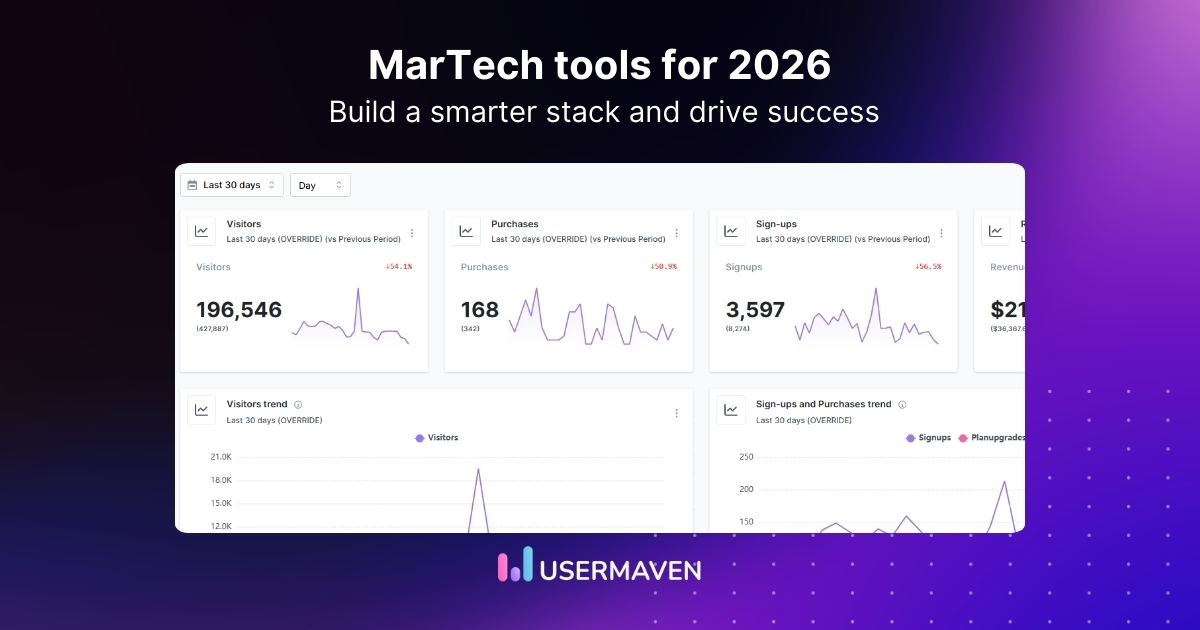
As we head into 2026, the world of marketing technology (MarTech) is evolving faster than ever. With an expanding range of tools, building a high-performing marketing stack is more important than ever for businesses of all sizes.
The challenge? Ensuring that each tool seamlessly integrates to enhance your marketing efforts.
The key to success lies in how well these tools work together across every touchpoint of the customer journey. From the first interaction to post-purchase, each moment is an opportunity to create personalized, engaging experiences.
Ready to build your marketing powerhouse? Let’s dive in.
Quick comparison
We selected these tools based on key 2026 priorities: ease of use, scalability, integration, automation, privacy, and overall value relative to cost and complexity.
| Tool | Best For | Core Functions | Notable Strength | Pricing Approach |
| Usermaven | Marketing teams and businesses focused on attribution and website analytics | Attribution tracking, website user analytics, customer journey insights, conversion tracking | Automatic event tracking and ad blocker bypass for accurate data collection | Tiered pricing with a free trial, based on features and usage volume |
| Ketch | Privacy, consent, and data governance | Privacy workflows, consent management, data subject requests | End-to-end, AI-ready privacy automation | Tiered / enterprise-focused |
| RedTrack | Performance marketers | Full-funnel conversion tracking, multi-touch attribution | Privacy-first tracking | Tiered/event-based |
| Replug | Marketers, social media influencers, and agencies | Branded link shortening & customization, deep link analytics, bio-link pages, retargeting pixels, CTA generators, A/B testing, QR codes, & more | Turns every shared link into a growth asset with analytics + branding | Free/monthly + annual plans. |
| Contentpen | Content marketing and SEO teams | AI, SEO- and GEO-optimized content writing | End-to-end content lifecycle with built-in brand control | Free trial + subscription tiers |
| HubSpot Marketing Hub | All-in-one automation for growth teams | CRM, email, automation, analytics, ABM | Powerful yet accessible all-in-one platform | Free tier plus paid tiers |
| Twilio Segment | Unified customer data | CDP, real-time data routing, identity resolution | 700+ connectors and strong governance features | Usage-based |
| Jasper | AI-powered content operations | Content automation, AI writing, brand control | Purpose-built AI platform for marketing teams | Subscription tiers |
| GPTZero | Content marketers that need to verify AI‑generated content and check originality and grammar before publishing. | Verifying AI-generated content for originality and grammar checks. | Efficient AI content detection and plagiarism checking. | Free tier plus paid tiers |
| Hotjar | UX and conversion insights | Heatmaps, session replay, surveys, feedback | Fast visual insight into user behavior | Subscription tiers |
| Mutiny | B2B website personalization | AI personalization, no-code experiments, LinkedIn campaigns | No-code, AI-driven 1:1 web experiences | Custom / usage-based |
| Braze | Cross-channel engagement | Heatmaps, session replay, surveys, feedback | Real-time, cross-channel engagement with BrazeAI | Tiered enterprise pricing |
| Adobe Marketo Engage | Enterprise marketing automation | Lead lifecycle, scoring, nurture, ABM | Deep automation and B2B-focused features | Enterprise contracts |
| SendPulse | Multi-channel automation. | Unified platform for email, SMS, chatbots (WhatsApp/IG), CRM, and landing pages. | Automation 360 for multiple communication channels into a single customer journey. | Free tier plus paid tiers |
1. Usermaven
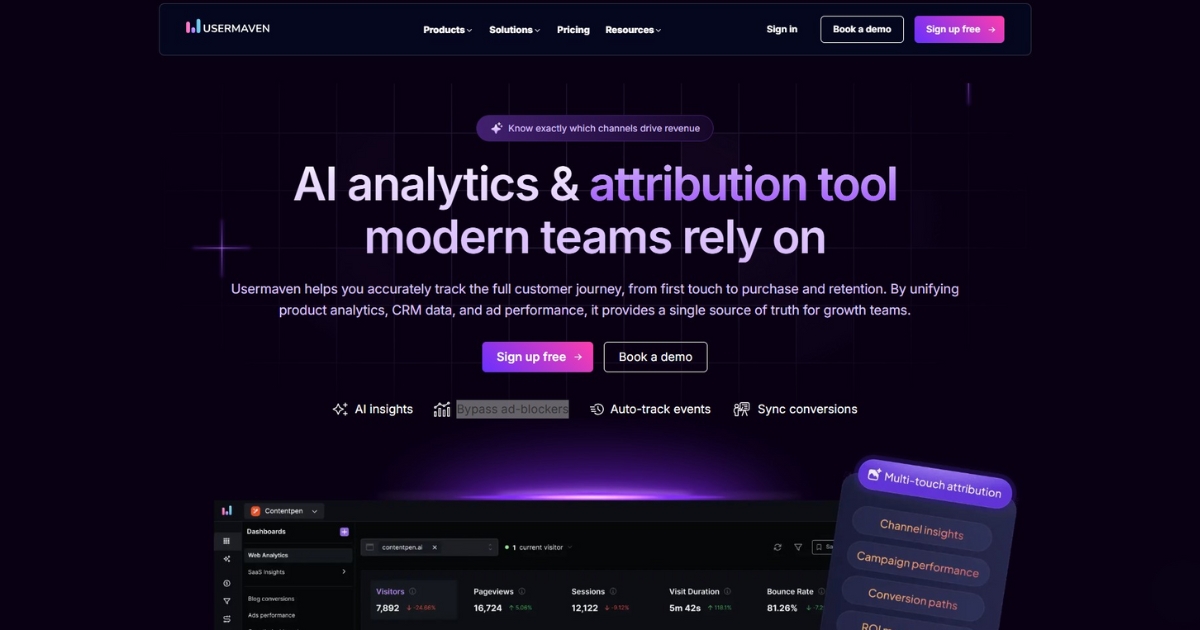
Usermaven is a powerful attribution tool designed to help businesses optimize their customer journeys with ease. It specializes in automatic event tracking, making it easy to capture every user interaction without manual setup. This means you can effortlessly track key actions across your website or app and gather valuable data on user behavior.
Usermaven ensures accurate data collection by bypassing ad blockers, allowing you to track user behavior without interruptions. Combined with real-time reporting, this feature enables you to make data-driven decisions on the fly, optimizing your strategies as insights roll in.
Teams use Usermaven for attribution and website analytics, leveraging automatic event tracking to gain deep insights into user interactions. It’s a privacy-friendly tool that ensures compliance while providing accurate, real-time data.
Key strengths:
- Track marketing impact with seven attribution models and a 180-day lookback window
- Optimize retention and conversion by analyzing attribution data
- Leverage AI to spot engagement patterns, drop-offs, and trends
- Visualize the whole user journey for a complete view of user behavior
- Analyze funnel stages to identify top channels and drop-off points
- Monitor user behavior in real time for faster decision-making
- Ensure EU data hosting for privacy compliance
Limitation:
All-in-one analytics capabilities make it tough to justify keeping extra specialized tools in the stack
Maximize your ROI
with accurate attribution
*No credit card required
2. Ketch
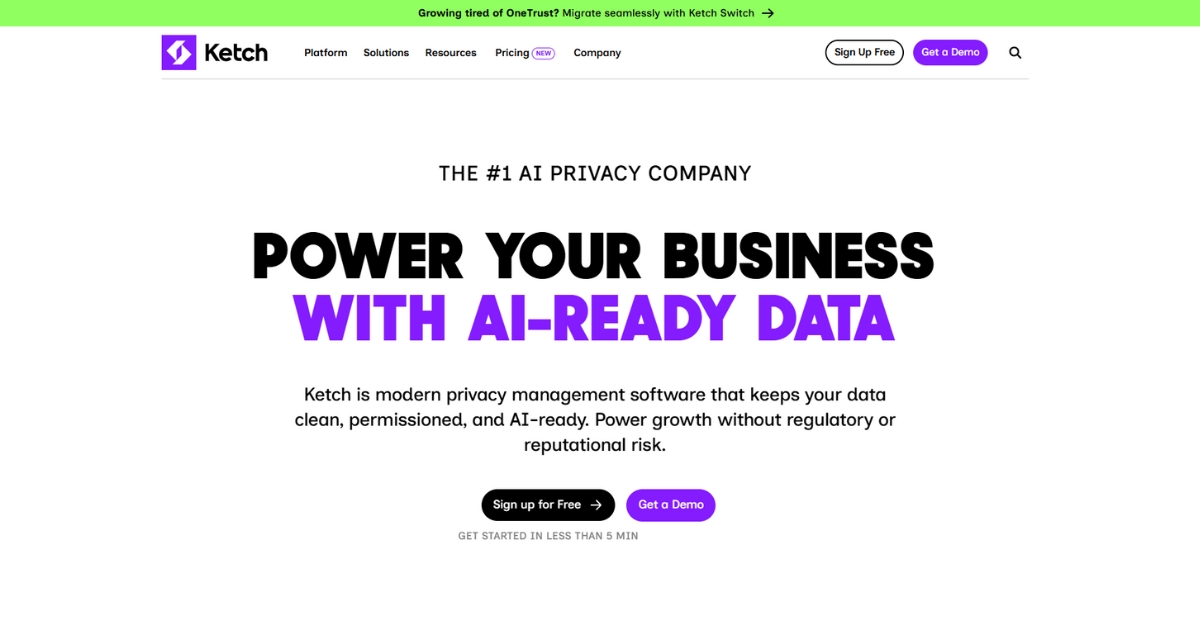
Ketch is a data privacy and AI governance platform built for companies that treat privacy as a core operational requirement. It supports global consent, data subject request workflows, and automated privacy policy enforcement across your entire stack.
Ketch helps organizations adapt to evolving regional regulations with dynamic policy templates and real-time consent orchestration. Its automation capabilities reduce manual privacy operations while ensuring every downstream system adheres to user preferences.
Teams typically use Ketch to operationalize privacy across marketing, data, and product workflows, creating a consistent foundation for compliant data activation.
Key strengths:
- Real-time privacy and consent orchestration
- Automated workflows for privacy compliance
- Flexible global policy management
- Integrates with activation tools for end-to-end governance
- Strong fit for multi-region, data-heavy organizations
Limitation:
Works best with cross-functional adoption across marketing, legal, and data teams
3. RedTrack
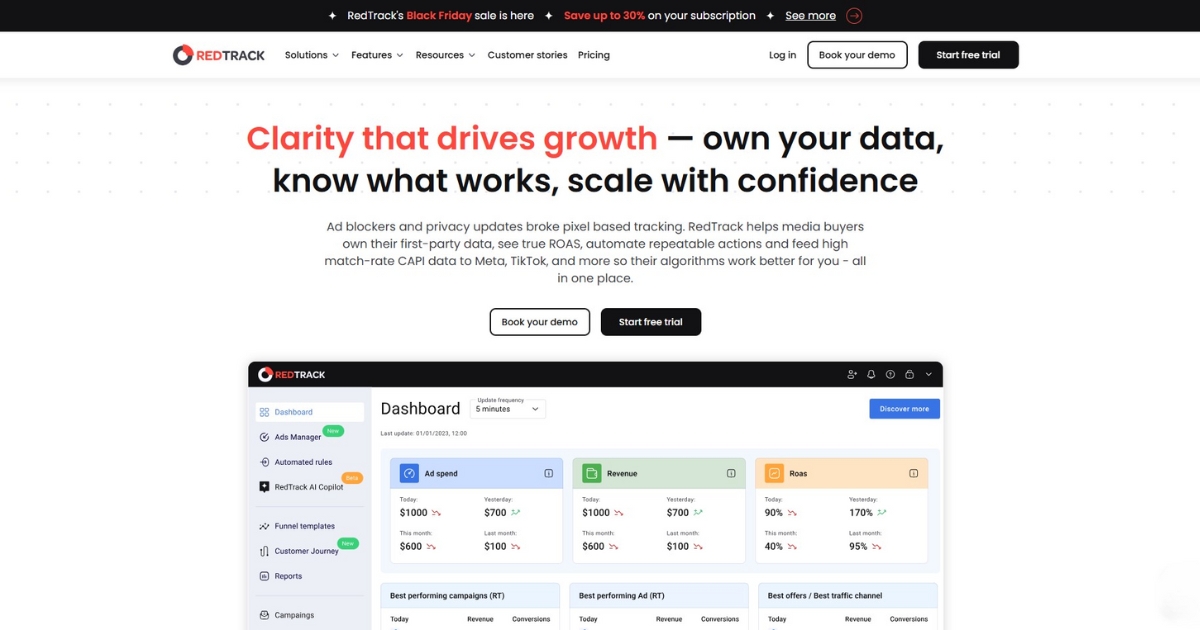
RedTrack is a performance marketing and attribution platform designed for media buyers, affiliates, and marketing teams that need accurate tracking, attribution, and campaign automation across multiple channels. It centralizes conversion data, ensures compliance with first-party data requirements, and enables advanced automation to optimize campaigns in real time.
Teams typically use RedTrack to monitor campaign performance, automate spend and optimization rules, prevent ad fraud, and integrate conversion data with ad platforms for accurate reporting and ROI analysis.
Key strengths:
- Full-funnel conversion tracking across client-side and server-side environments
- Multi-touch attribution and accurate ROI measurement
- Automation rules for pausing, scaling, or optimizing campaigns in real time
- Fraud detection and bot protection
- Integration with 200+ ad networks, CRMs, and e-commerce platforms
Limitation:
- Requires technical setup and careful configuration to ensure accurate attribution
4. Replug
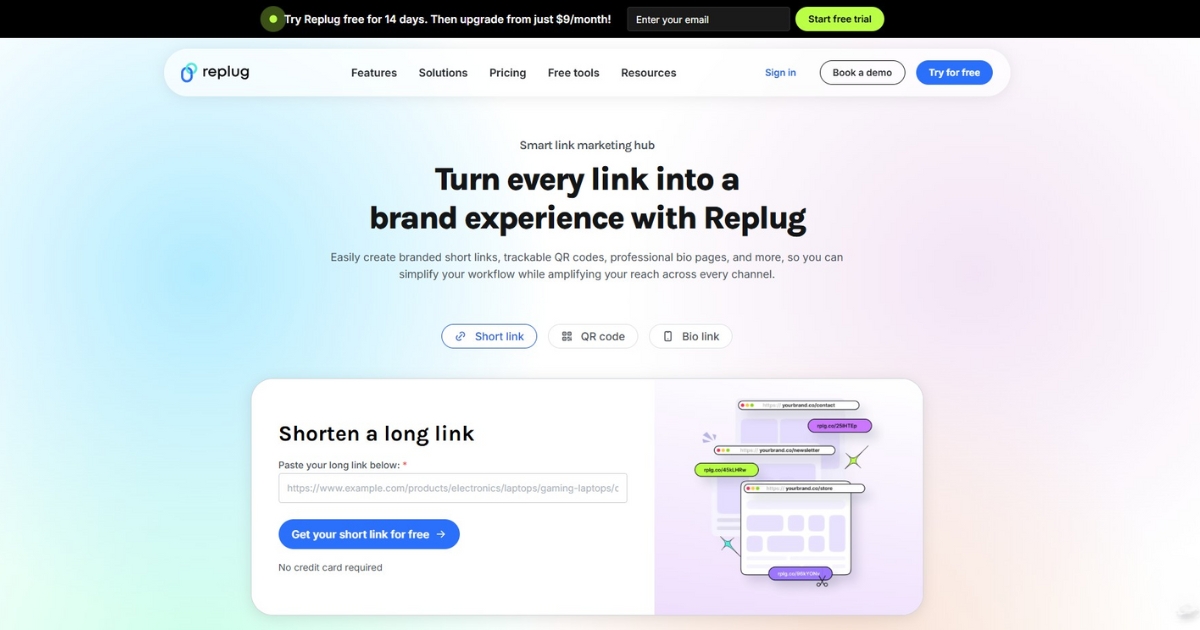
Replug is a leading MarTech link marketing platform designed to help brands and social media marketers turn every shared link into a measurable growth asset.
It excels in creating branded short links that replace long, messy URLs with clean, memorable ones using your brand name. Perfect for social posts, SMS, ads, and other campaigns while also providing tracking and analytics to measure performance.
Beyond shortening links, Replug offers a remarkable bio links feature. It lets content marketers and influencers build custom landing pages that connect all content, offers, products, and social profiles under a single branded URL.
These bio pages are ideal for Instagram, TikTok, LinkedIn, and more, helping creators, agencies, and businesses drive traffic where it matters most. Plus, they help convert clicks into measurable results.
By combining branded links with analytics and customizable bio pages, Replug empowers marketers to improve engagement, strengthen brand visibility, and track every click across social channels. This makes it a top-notch tool in modern social media marketing.
Key strengths:
- Branded short link creation for professional and trustworthy social media marketing
- Custom bio links pages that centralize content, products, and offers
- Detailed click tracking and analytics across campaigns
- Retargeting and deep linking options for smarter engagement
Limitation:
- May require a short learning curve for users unfamiliar with advanced link marketing tools
5. Contentpen
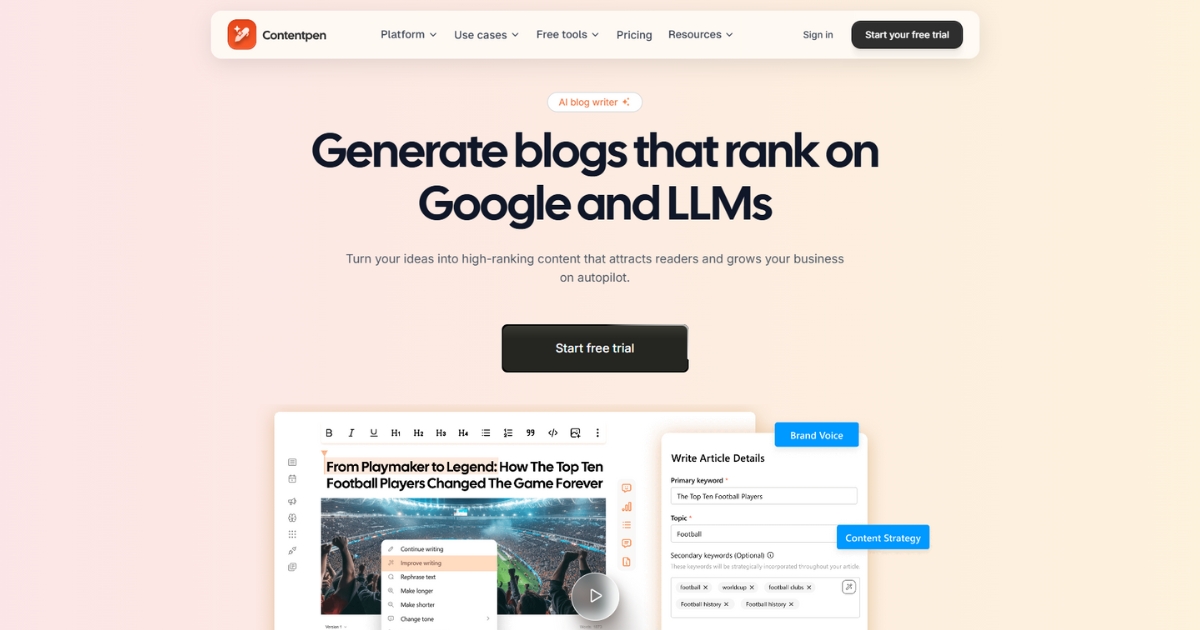
Contentpen is an AI-powered blogging platform designed to help teams research, write, optimize, and publish high-performing content at scale. Our AI blog writer supports the entire content lifecycle, covering ideation, SEO scoring, writing, collaboration, publishing, and analytics.
The platform combines keyword research, internal linking, and team workflows into one unified system. Its built-in search engine optimization features ensure every piece is ready to rank higher on SERPs while remaining perfectly readable for users. Contentpen integrates with your existing CMS platforms, such as WordPress, Ghost, etc., and your existing marketing tool stack via webhooks.
Marketing teams use Contentpen to streamline editorial workflows, reduce production time, and create content in bulk without sacrificing quality.
Key strengths:
- End-to-end content workflow, including research, writing, optimization, and publishing
- Built-in SEO tools for keyword clustering and analyzing ranking opportunities
- AI-powered content generation with brand voice control
- Analytics and keyword opportunities to guide your content marketing strategy
- Internal and external linking recommendations to boost topical authority
Limitation:
The functionalities may overlap with standalone SEO or CMS tools in some stacks
6. HubSpot Marketing Hub
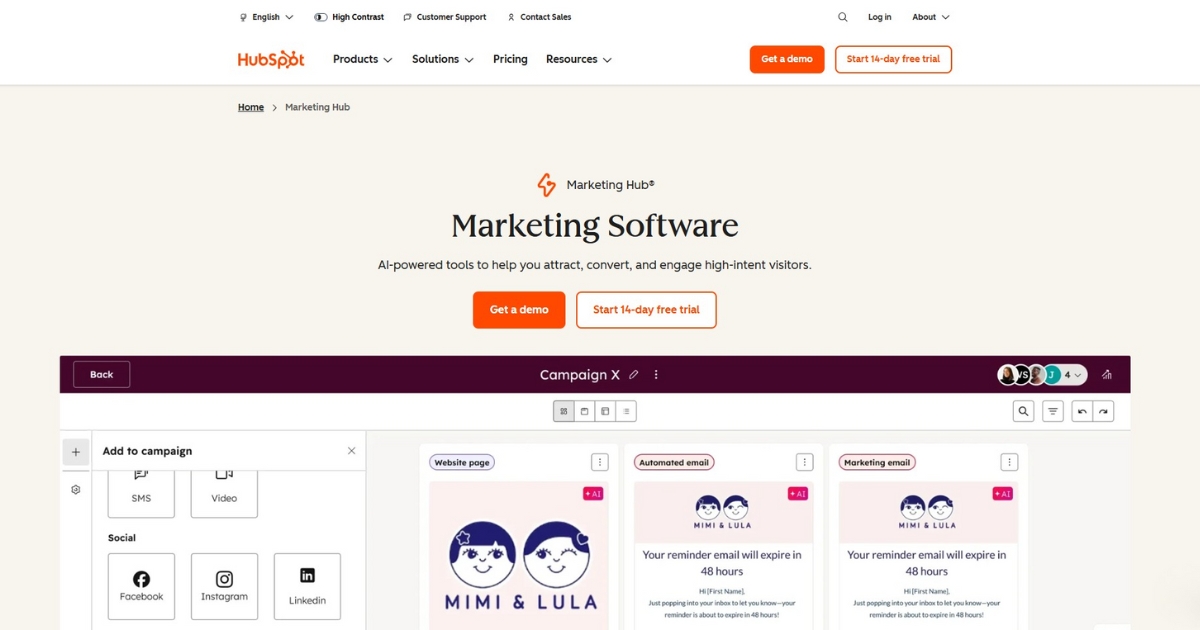
HubSpot Marketing Hub is an all-in-one platform combining CRM, email, automation, and analytics. It’s ideal for small and midsize teams that want robust capabilities without complex implementation.
The platform includes AI content assistance, landing page tools, ABM features, lead scoring, and revenue attribution. Because it’s built on the same foundation as HubSpot’s CRM, teams can manage the entire customer lifecycle in a single unified system.
Teams typically use HubSpot for lead capture, nurture programs, lifecycle automation, and growth reporting.
Key strengths:
- Unified CRM and marketing automation
- Easy onboarding with a clean interface
- Strong attribution and reporting
- AI-assisted content and optimization tools
Limitation:
- Very advanced enterprise use cases may require complementary systems
7. Twilio Segment
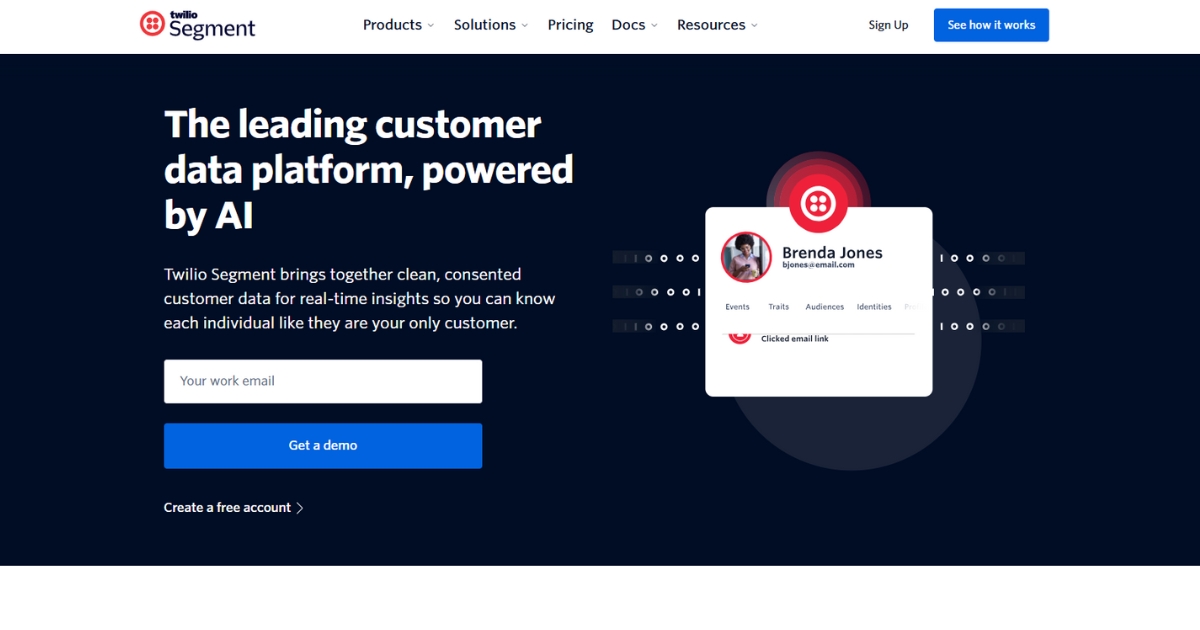
Twilio Segment is a customer data platform that centralizes behavioral and profile data across your stack. It’s best for teams that need clean, consistent data to power personalization and analytics.
Segment provides event tracking, identity resolution, audience building, and extensive integrations across analytics, advertising, and automation tools. It functions as the data foundation for many modern martech stacks.
Teams use Segment to create unified customer profiles, standardize data, and route insights to the right tools in real time.
Key strengths:
- Real-time data routing and governance
- Highly reliable identity resolution
- Extensive integration catalog
- Enables personalization and accurate reporting
Limitation:
Costs can rise with event volume and destinations
8. Jasper
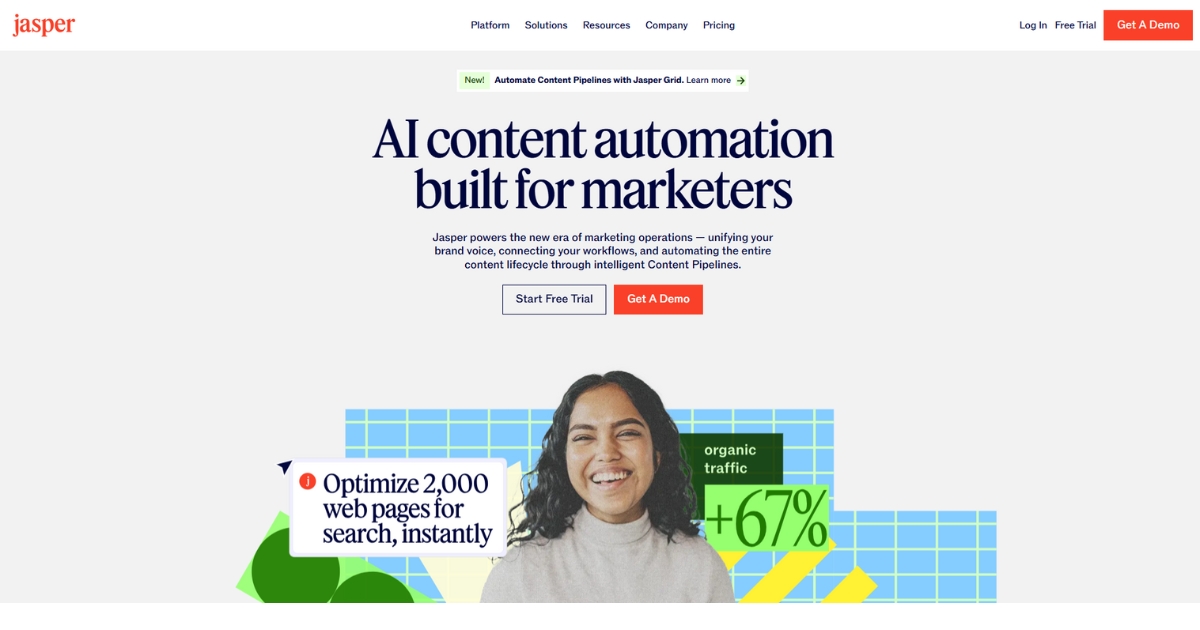
Jasper is an AI content platform designed specifically for marketing teams. It focuses on content planning, writing, and scaling campaigns while maintaining brand guidelines.
The platform includes brand voice controls, an intelligent context layer, and tools for generating both long-form content and derivative assets across channels. It supports consistent messaging across teams and geographies.
Marketing teams use Jasper to accelerate content production workflows while maintaining editorial quality.
Key strengths:
- Strong brand voice and governance controls
- Multifunction AI for text and visuals
- Helps scale content across channels
- Supports both ideation and execution
Limitation:
Human editing remains important for strategic assets
9. GPTZero
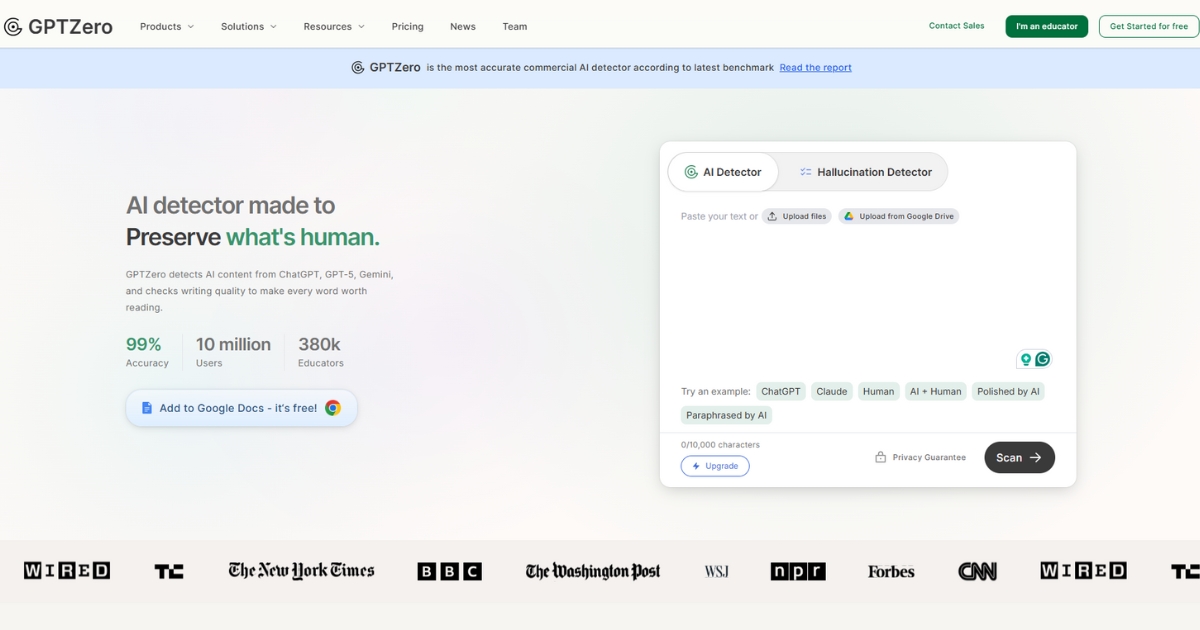
GPTZero is the earliest and finest AI detector and quality-assurance tool designed for teams that already rely on AI writers and want an extra layer of control before publishing.
Marketing teams typically use GPTZero to scan blog posts, landing pages, email sequences, and other campaign assets created with tools like Jasper. The platform flags passages likely generated by AI, supports originality checks, and surfaces risk levels so editors know where to focus their review time.
Beyond AI detection, GPTZero also offers supporting tools such as a plagiarism checker and grammar checker, giving teams a single workspace to validate originality and clean up language before content goes live. This makes it easier to fold quality checks into existing editorial workflows without juggling multiple disconnected apps.
Key strengths:
- Detects likely AI-generated content in drafts so editors know where to focus review
- Supports originality checks to reduce plagiarism risk and protect brand trust
- Includes built-in tools like a plagiarism checker and a grammar checker for one-stop quality control
- Offers batch analysis and reporting to monitor content quality across multiple campaigns and channels
Limitation:
- Works best as a supplement to strong editorial processes, not a replacement for human review and judgment
10. Hotjar
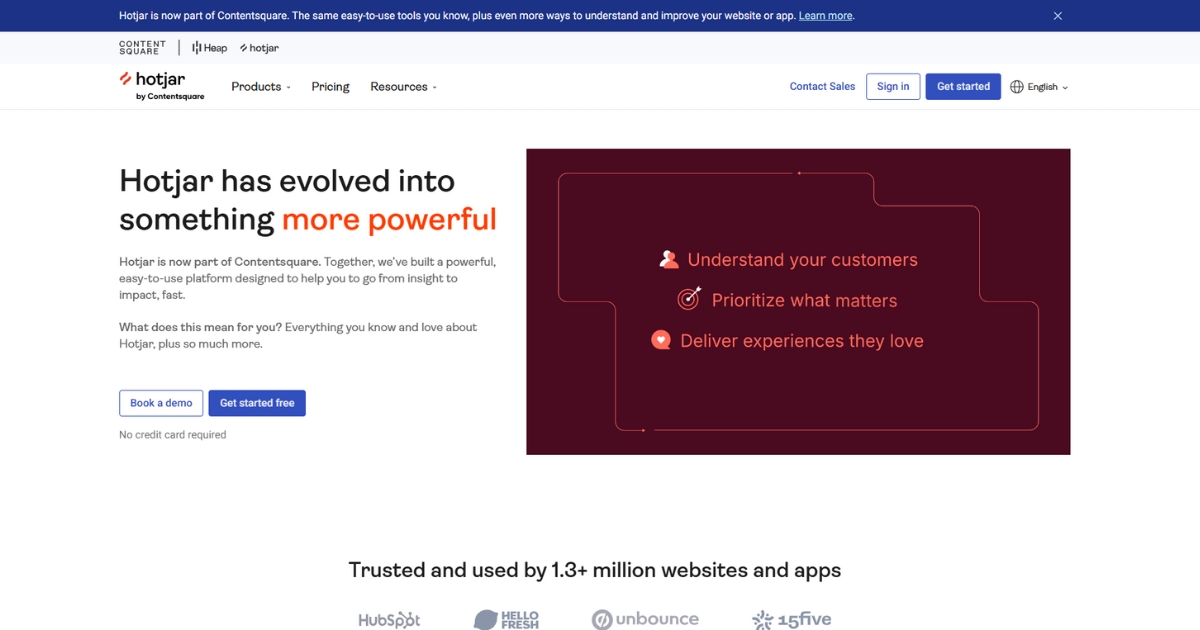
Hotjar provides behavior analytics through heatmaps, session replays, surveys, and feedback tools. It’s ideal for teams that need qualitative insight into user behavior with minimal setup.
The platform highlights where users click, scroll, hesitate, or drop off, helping teams quickly spot friction and prioritize UX improvements.
Teams use Hotjar for conversion optimization, landing page improvements, and UX validation.
Key strengths:
- Visual insights without a heavy analytics setup
- Useful for CRO and product/marketing alignment
- Simple deployment
- Complementary feedback and survey tools
Limitation:
- Not designed for advanced quantitative analytics
11. Mutiny
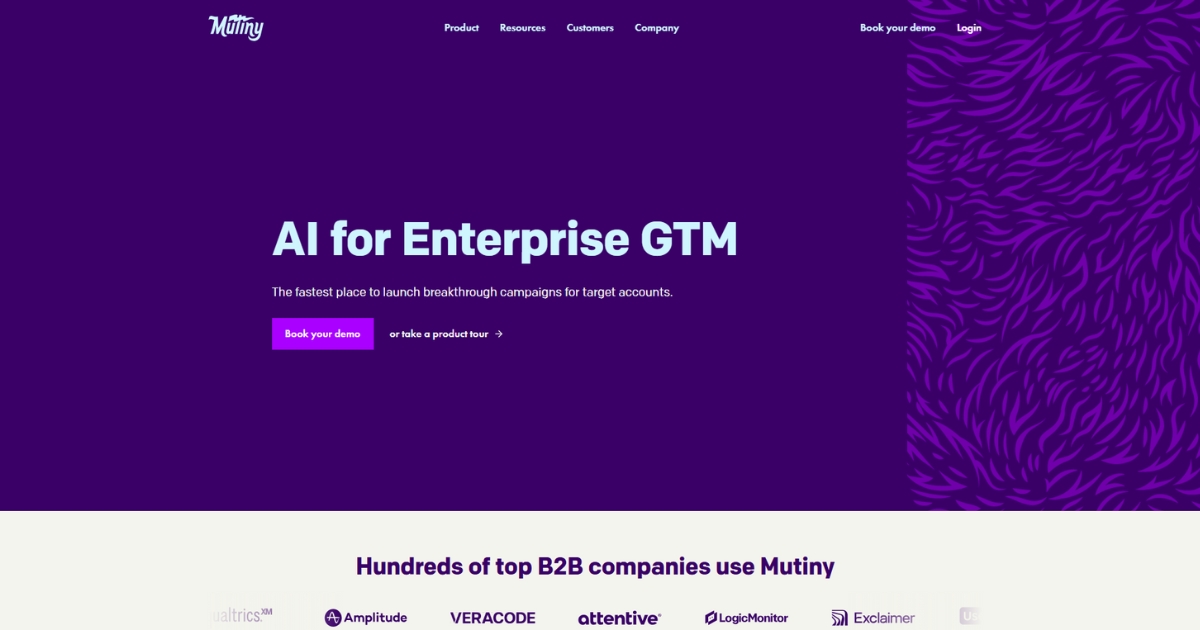
Mutiny is a no-code personalization platform built for B2B teams. It helps marketers create segmented website experiences, landing page variations, and targeted campaigns without engineering support.
AI assists with creative suggestions, segmentation insights, and experiment ideas. Mutiny also supports targeted campaigns for account-based programs.
Teams use Mutiny to improve conversion rates, tailor experiences to high-intent audiences, and accelerate pipeline creation.
Key strengths:
- No-code personalization for B2B growth
- AI recommendations for creative and experiments
- Strong alignment with ABM workflows
- Quick impact on conversion-focused pages
Limitation:
Works best with established traffic and defined account lists
12. Braze
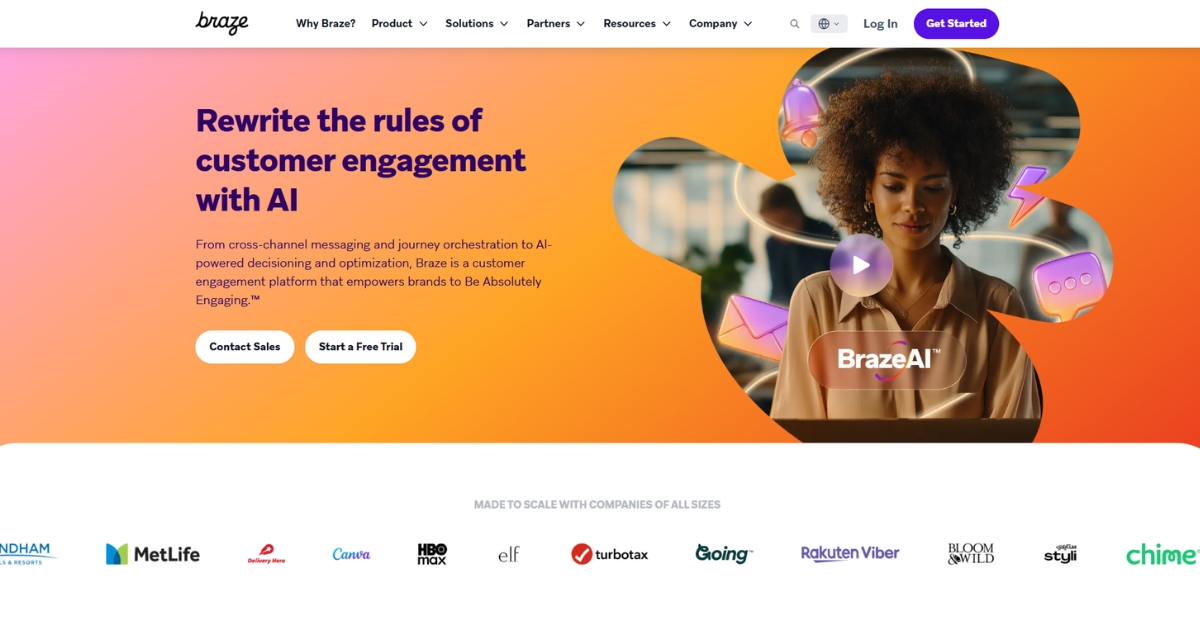
Braze is a cross-channel customer engagement platform that enables real-time messaging across email, push, SMS, web, and in-app channels.
Its orchestration engine, segmentation tools, and AI optimization features support sophisticated lifecycle programs. Braze is designed for brands that need flexible, data-driven messaging at scale.
Growth and lifecycle teams use Braze for onboarding flows, retention campaigns, re-engagement, and real-time triggered experiences.
Key strengths:
- Real-time, multi-channel orchestration
- AI-assisted targeting and experimentation
- Rich journey analytics
- Strong fit for consumer and app-led businesses
Limitation:
- Typically requires structured implementation and data readiness
13. Adobe Marketo Engage
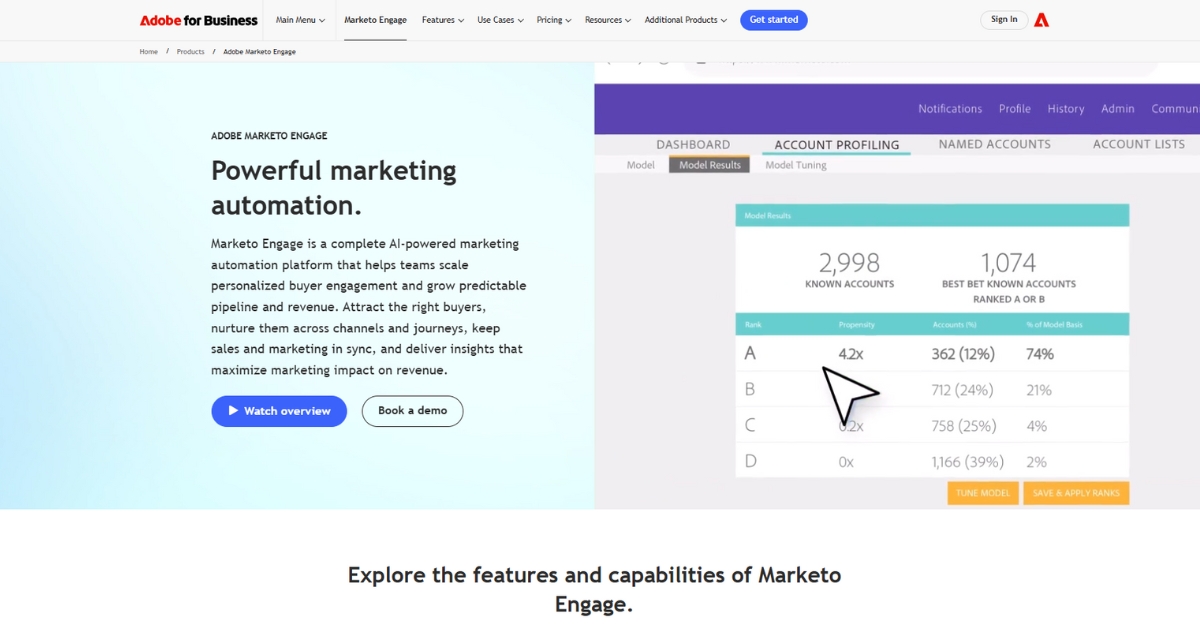
Adobe Marketo Engage is an enterprise-grade marketing automation platform known for deep lead lifecycle management and sophisticated nurture workflows. It’s a strong fit for B2B enterprises.
Marketo supports multi-step automation, scoring models, ABM workflows, and advanced segmentation. Its flexibility and maturity make it a central engine for large marketing operations.
Teams use Marketo to manage email, lead nurturing, segmentation, and pipeline acceleration across complex buyer journeys.
Key strengths:
- Highly flexible automation for complex workflows
- Strong lead scoring and lifecycle management
- Rich integrations with enterprise CRMs
- Mature ecosystem of experts and partners
Limitation:
- Steep learning curve; usually requires dedicated ops support
14. SendPulse

SendPulse is a multichannel marketing platform combining CRM, email marketing, and chatbots. It’s ideal for small and midsize businesses seeking broad communication reach without enterprise-level pricing.
The platform includes an AI-powered email and landing page builder, CRM with WhatsApp and Instagram integration, transactional email via SMTP, and a chatbot builder for platforms like WhatsApp, Instagram, Facebook Messenger, and even TikTok. Because it consolidates multiple channels into one interface, businesses can manage audience engagement across touchpoints without juggling separate tools.
Teams typically use SendPulse for email and SMS campaigns, automated drip sequences, subscriber re-engagement, and chatbot-driven lead capture.
Key strengths:
- Multichannel outreach from a single platform
- Affordable pricing with a generous free tier
- Built-in chatbot builder and live chat across major messaging apps
- Flexible automation with a visual workflow editor
Limitation:
- Reporting and analytics are less advanced compared to dedicated marketing intelligence platforms
Final thoughts
As we head into 2026, a high-performing marketing stack is non-negotiable.
To succeed, your stack must be agile, integrated, and capable of driving meaningful customer interactions. It’s about choosing tools that not only streamline processes but also empower smarter, faster decision-making.
Marketers who can harness their tech stack to move quickly, stay relevant, and anticipate customer needs will be the ones leading the charge.
The right tools won’t just support your goals; they’ll elevate them.
FAQs about MarTech tools
1. What is a martech stack?
A martech stack is the collection of tools used to manage data, run campaigns, automate workflows, and measure performance.
2. How many martech tools should a team use?
Most teams use between 5 and 20 core tools, depending on scale and complexity.
3. Where should I start if my stack needs improvement?
Begin with data foundations and privacy posture, then optimize activation tools around that.
4. Do AI tools replace traditional martech?
No. AI enhances content creation, targeting, and decision-making but does not replace core data or automation infrastructure.
5. How often should teams reevaluate their stack?
Quarterly reviews are helpful, with annual deep evaluations tied to your budgeting cycle.