Choosing analytics used to feel simple. Pick a tool, add tracking, and expect clean answers.
Now, expectations are sharper. Marketing teams need marketing attribution that holds up when budget decisions are on the line. Product teams want real-time behavior, not delayed reports. And across the board, privacy compliance is no longer optional.
That’s why the Mixpanel vs. Amplitude vs. Usermaven question keeps coming up. All three help you understand what users do, but they approach implementation, reporting, and day-to-day usability differently.
And for a lot of teams, this comparison starts because they’re looking for an Amplitude alternative or a Mixpanel alternative that’s easier to run week to week.
So instead of picking a winner in the abstract, let’s break down where each platform shines and which one makes the most sense for your team.
Understanding the basics: Mixpanel vs. Amplitude vs. Usermaven
Mixpanel has long been recognized as a dedicated product analytics tool, focusing primarily on user behavior tracking and engagement metrics. While it offers robust features for product teams, its implementation often requires significant technical expertise, which can be a barrier for many organizations. The platform excels at tracking specific product metrics but may fall short in comprehensive website analytics and attribution.
Amplitude compared to Mixpanel usually comes down to how much structure you’re willing to maintain for the depth you get back. Amplitude is built for teams that want a very detailed view of product behavior and are willing to invest in setup to get there. That depth comes with more moving parts, which can mean a longer rollout and more internal coordination, especially in larger organizations where multiple teams need to stay aligned.
Usermaven: The next generation analytics solution
Usermaven represents a new approach to analytics, combining AI-powered insights with user-friendliness. The platform stands out by offering:
- Comprehensive solution for both website and product analytics
- Advanced attribution
- Automated event tracking without coding requirements
- AI-powered insights for immediate action
- Privacy-first approach with GDPR and CCPA compliance
- Seamless integration capabilities
Interested in how other tools compare? Check out our Heap vs. Amplitude vs. Usermaven blog for a deeper breakdown.
See Usermaven in action
Book a free demo and discover how powerful analytics can grow your business.
*No credit card required
Setup and implementation
Usermaven is designed to be straightforward from the start. You can begin tracking and reporting without a long setup cycle, and it stays usable for people who are not technical. That makes it easier to keep analytics part of everyday work rather than a specialist task.
Mixpanel typically needs more upfront structure. You can get started, but the quality of your reporting depends on how clearly your tracking is defined. Many teams involve a developer to set it up well and to keep tracking consistently as the product changes.
Amplitude generally asks for the most discipline. It works best when teams invest time in defining events, naming conventions, and shared rules early. The payoff is depth, but it often takes longer to reach a clean, reliable setup.
This is also where the Amplitude or Mixpanel API question becomes relevant. If you plan to pipe data into other tools or build custom reporting, the upfront setup work determines how useful those integrations will be later.
| Setup focus | Usermaven | Mixpanel | Amplitude |
| Time to useful insights | Fast | Medium | Slower |
| Tracking effort | Lighter upfront | More deliberate | Most structured |
| Ongoing maintenance | Lower | Medium | Higher |
| Best fit | Teams that want clarity quickly | Teams that can invest in instrumentation | Teams with mature analytics ops |
Privacy and data accuracy
Usermaven takes a clear approach to privacy. It hosts data in EU-based data centers and supports cookie-less tracking, with options designed to help keep reporting more consistent even as browsers and ad blockers get stricter.
Mixpanel can support EU data residency, but it’s something you choose during setup. You select whether the project is hosted in the US or the EU, and that choice affects where data is stored going forward.
Amplitude puts more emphasis on formal privacy processes. It highlights GDPR and CCPA support, provides tools to handle privacy requests, and also offers EU hosting as an option.
AI-powered analytics
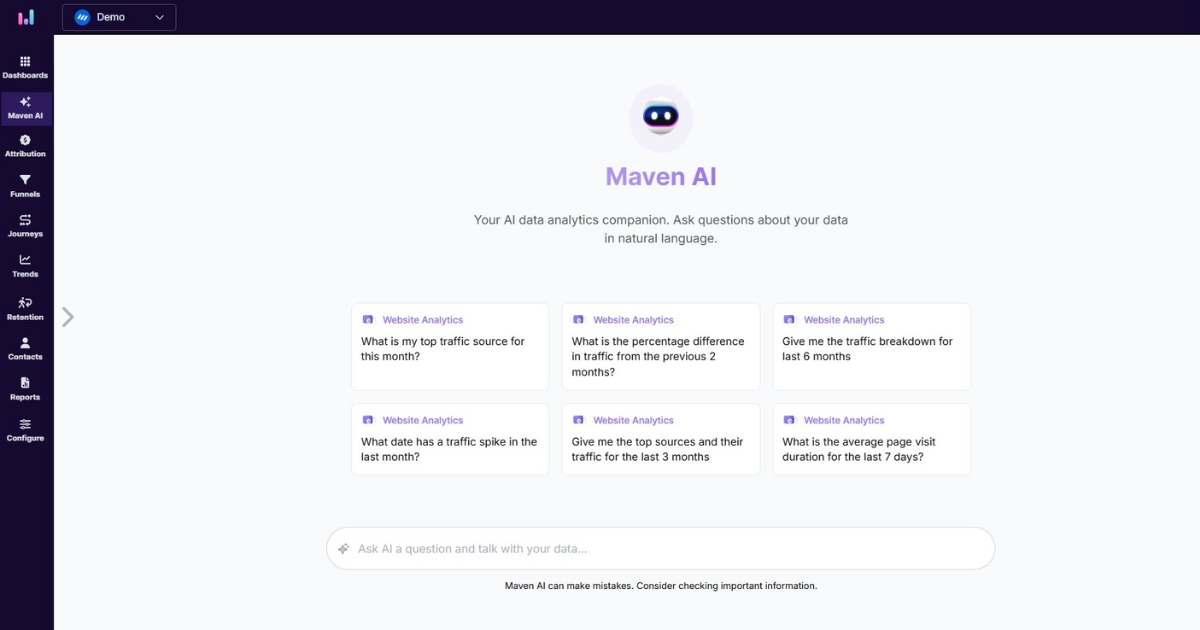
Usermaven does a good job keeping AI tied to everyday workflows. Maven AI lets you ask questions in plain language and get answers as charts. The platform leverages AI across all major functions, offering automated attribution analysis, funnel suggestions, and automated customer journey mapping.
Mixpanel offers Spark, which converts natural-language questions into reports such as Funnels, Retention, and Flows. The main trade-off is that Spark usage is metered by a monthly query allowance, so teams that rely heavily on AI tend to hit that ceiling sooner.
Amplitude includes Ask Amplitude for conversational chart creation and editing. It also offers AI-driven analysis on charts, including funnels, through Automated Insights. Where it differs is the flow. Amplitude’s AI is most useful once you’re already looking at a report and want help understanding it, rather than steering you toward the next best analysis to run.
| AI feature | Usermaven | Mixpanel | Amplitude |
| Built-in AI assistant | Maven AI | Spark | Ask Amplitude |
| AI limits shown publicly | No AI prompt/query cap shown on pricing | Spark queries capped by plan (30 / 60 / 300) | AI prompts capped by plan (500 / 1,000 / 2,500 / 5,000) |
Product analytics and feature adoption
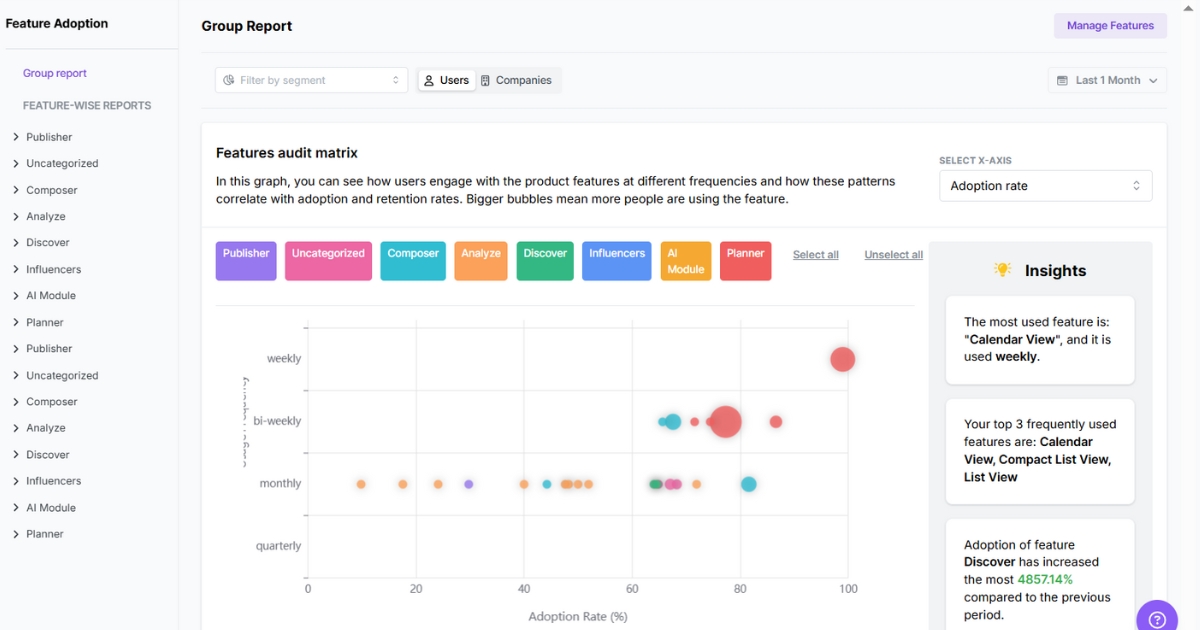
Usermaven is built for quick momentum in product analytics. You get automatic event capture, plus clear tools for funnels, journeys, segments, and cohorts. It also includes a dedicated feature adoption view, so product teams can track uptake without spending the first week assembling reports.
Mixpanel is very capable, especially once your tracking is tidy. It supports auto-capture and provides robust reports for funnels and user flows. The tradeoff is that teams often need a bit more time to settle on event names, structure, and reporting conventions before everything feels effortless.
Amplitude offers deep analysis and a lot of flexibility. It also supports autocapture and has robust cohorting and funnel tools. In practice, it tends to pay off most when teams invest early in shared definitions, because that’s what keeps charts consistent across product, growth, and data stakeholders.
| Capability | Usermaven | Mixpanel | Amplitude |
| Automatic event capture | Yes | Yes | Yes |
| Funnels | Yes | Yes | Yes |
| User paths/journeys | Yes | Yes | Yes |
| Segments/cohorts | Yes | Yes | Yes |
| Feature adoption tracking | Built-in view | Built from events + cohorts | Built from events + cohorts |
Marketing attribution and channel analysis
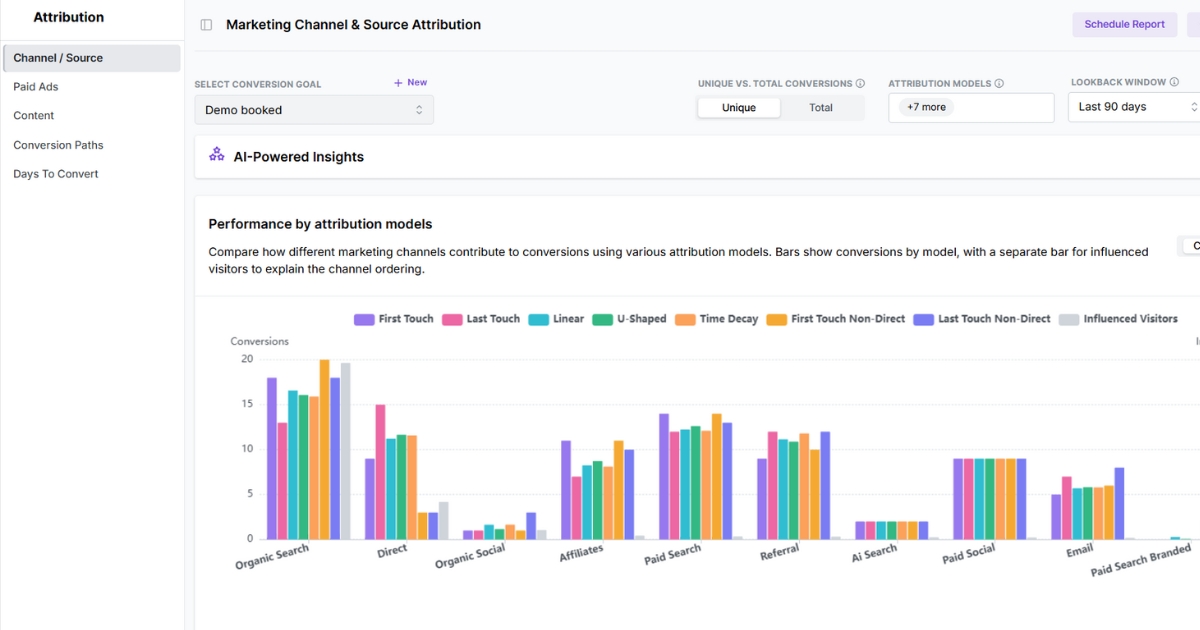
Usermaven supports seven attribution models, and the attribution window can go up to 365 days, which is important if your buyers don’t convert in a week. It also includes spend-period attribution with a look-ahead option, so you can judge a campaign by the period you spent money, while still counting conversions that happen after the campaign ends.
Mixpanel can handle attribution, but it typically feels more like something you configure than something you open and immediately trust. The model and window settings matter, and the quality of your output depends heavily on how consistently you tag and define things.
Amplitude is similar. It supports attribution and flexible windows, but it tends to assume you already have clean campaign tagging and stable conversion definitions. If those inputs are messy, the output is messy too.
| Feature | Usermaven | Mixpanel | Amplitude |
| Attribution models | Multiple models | Multiple models | Multiple models (incl. data-driven) |
| Max attribution window | 365 days | 30 days by default, adjustable | Up to 365 days |
| Spend-period attribution | Yes | No | No |
| Look-ahead option | Yes | No | No |
| Day-to-day experience | More marketer-ready | More setup to keep clean | More setup to keep clean |
Funnel analysis
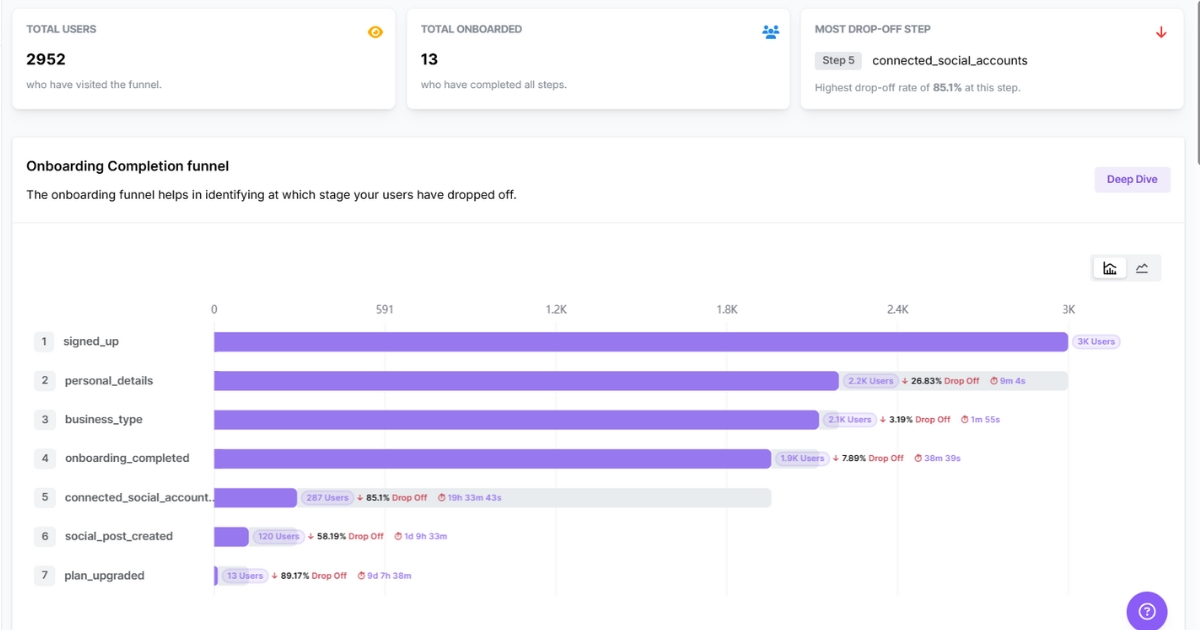
Usermaven makes funnels more guided with AI-powered capabilities. It can suggest the right funnels to track based on your goal, then highlight drop-off rate and provide practical recommendations to improve conversion rates. You can build funnels automatically or customize them as needed, so teams can spot bottlenecks faster and act without a long back-and-forth.
Mixpanel is strong at funnel reporting, but it’s more self-directed. You build the funnel you want, then interpret the results. It also offers AI support (Spark), but that support is metered by a monthly query limit, which can make it feel less “always-on” if many people rely on it.
Amplitude also offers robust funnel analysis and AI-powered chart help. Similar to Mixpanel, the AI layer is useful once you’re already looking at a funnel, but it’s typically prompt-based and capped by plan, and it’s less about guiding you to the best funnel to track in the first place.
| Funnel capability | Usermaven | Mixpanel | Amplitude |
| Funnel setup style | Guided (suggests funnels) | You choose and build | You choose and build |
| Drop-off visibility | Clear drop-off steps | Clear drop-off steps | Clear drop-off steps |
| AI help for funnels | Suggestions + insights | AI help, query-capped | AI help, prompt-capped |
| Best for teams that want speed | High | Medium | Medium |
Support and customer success
Usermaven keeps support straightforward and accessible. Teams can reach out when they need help, and onboarding support is available to get set up quickly. Clear documentation and practical resources make it easier to adopt the platform without a long ramp-up, reducing common setup roadblocks and accelerating time-to-value.
With Mixpanel, support is clearly tiered. Email support is available, but the level changes by plan (Standard, 24/5, 24/7). Key support upgrades, such as faster response SLAs and a shared Slack channel, are listed as add-ons, meaning you pay extra.
With Amplitude, meaningful support is also tied to higher plans. Customer support is tied to paid tiers, while customer success and an assigned account manager are reserved for Enterprise. Response times also get faster at higher levels.
| Support item | Usermaven | Mixpanel | Amplitude |
| Customer support access | Included | Included (tiered by plan) | Included on paid tiers |
| Faster response times | Included | Paid add-on | Higher tier |
| 24/7 support | Not positioned as a paid upgrade | Enterprise plan | Not shown in your plan table |
| Customer success/onboarding help | Included | Enterprise plan | Enterprise plan |
Pricing and value proposition
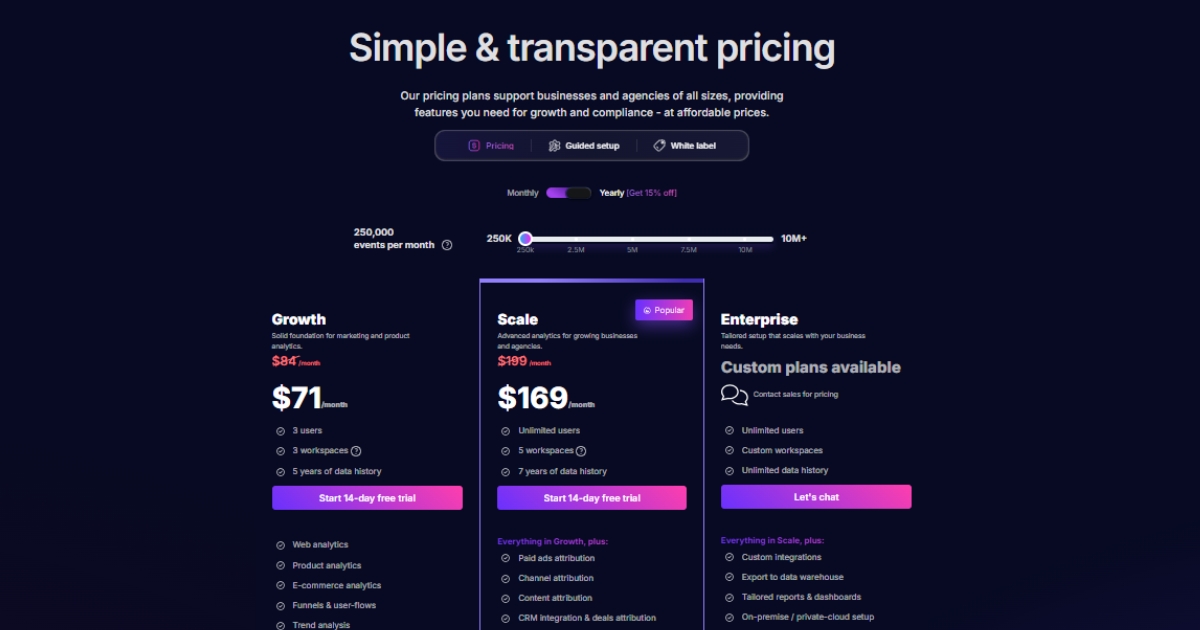
Usermaven is straightforward to budget for and quick to get started with. If you choose annual billing, you get a 15% discount, and the 14-day free trial gives you time to confirm tracking and reporting before you commit. Pricing is based on event volume, so the cost is predictable from day one. Growth starts at $71/month (250K events/month), and Scale is $169/month with unlimited users. There are no surprise charges, and if you exceed your event limit, tracking doesn’t shut off. Your plan simply moves to the next tier at the next billing cycle.
If implementation support would be helpful, there’s also a Guided setup and tracking plan add-on. It gives you expert guidance, a tracking plan tailored to your business, and structured help through setup and validation so you can launch with confidence.
Mixpanel pricing can look inexpensive at first, but it’s easier to underestimate the long-term cost because it’s priced around usage. The Growth plan starts with 1M monthly events free, then charges $0.28 per 1K events after (with volume discounts). That structure can be fine early on, but it becomes less predictable as you scale.
Amplitude has a clear entry point, but it’s also tiered around scale. If you look at Amplitude pricing, the Plus plan starts at $49/month and includes up to 300K MTUs or 25M events. Growth and Enterprise are custom, which often means pricing becomes a sales conversation once you want to scale.
| Pricing factor | Usermaven | Mixpanel | Amplitude |
| Free trial | 14-day free trial | Free plan available | Free plan available |
| Starting paid price | $71/month (Growth) | $0 to start, then usage-based | $49/month (Plus) |
| How costs scale | Clear event tiers | Pay more as events grow | MTUs/events, then custom pricing at higher tiers |
| “Surprise bill” risk | Low (predictable) | Medium (usage can spike) | Medium (moves to sales-led tiers) |
Making the right choice for your business
Here’s a quick way to decide which platform fits your team, budget, and setup needs.
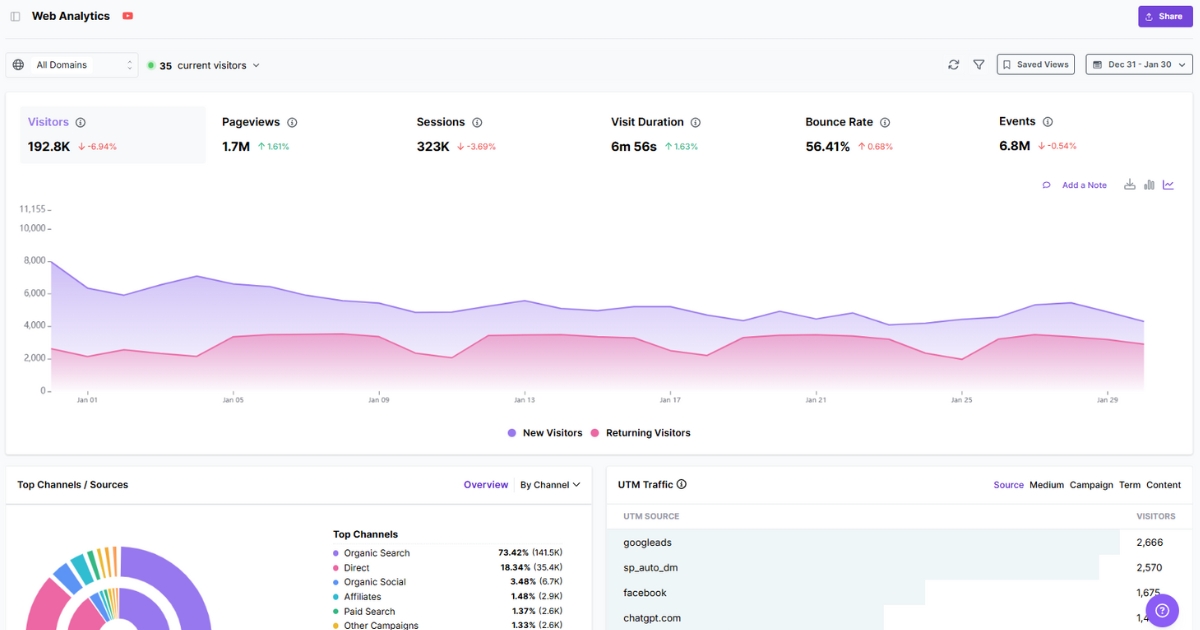
Choose Usermaven if you need:
- Quick implementation with minimal technical expertise
- Comprehensive AI-powered insights
- Privacy-compliant analytics
- Cost-effective solution with all features included
- Real-time, accurate data, even with ad-blockers
Consider Mixpanel if you:
- Have a technical team for implementation
- Focus primarily on product analytics
- Can invest in additional tools for comprehensive analytics
Look at Amplitude if you:
- Have enterprise-level requirements
- Can dedicate resources to platform management
- Need specific enterprise features
💡 Quick note: For another side-by-side comparison, take a look at our Mixpanel vs. FullStory vs. Usermaven blog.
Wrapping up
Mixpanel and Amplitude are both capable platforms, but they work best when you can consistently maintain tracking and keep reporting standards in place. If your priority is speed and alignment, the better choice is the tool that delivers clean answers without requiring ongoing effort to keep everything organized.
Usermaven is built for that. It’s a powerful website analytics tool that shows you what’s driving signups, which pages and flows convert, where people drop off, and what deserves credit across channels, all in a way your whole team can actually use.
Want to see it with your own data? Start a free trial, or book a demo, and we’ll walk through your tracking and reporting goals together.
FAQs
1. How does automatic event tracking compare across platforms?
Usermaven offers truly automatic event tracking with no coding required, while both Mixpanel and Amplitude require manual setup and technical implementation.
2. Which platform provides the best privacy compliance?
Usermaven leads with GDPR and CCPA compliance, EU-based hosting, and cookieless tracking options. While Mixpanel and Amplitude offer compliance features, they lack the comprehensive privacy-first approach of Usermaven.
3. How do AI capabilities differ between platforms?
Usermaven provides advanced AI features, including a Maven AI chatbot, intelligent funnel suggestions, and detailed user journey analysis. Mixpanel and Amplitude offer more basic capabilities.
4. What are the key differences in pricing models?
Usermaven offers transparent pricing starting at $84/month with all features included. Mixpanel and Amplitude use tiered pricing models that can become expensive as usage grows.
5. How do the platforms handle ad blockers?
Usermaven maintains 99% accuracy with ad blockers through pixel-white labeling technology, while Mixpanel and Amplitude may experience significant data loss.
6. Which platform offers the best support for non-technical users?
Usermaven provides the most user-friendly experience with no-code implementation and 24/7 support, making it ideal for non-technical users.
7. Is Usermaven a good alternative to Mixpanel and Amplitude?
Yes, Usermaven offers a compelling alternative with its AI-powered insights, automated tracking, and privacy-focused approach. It provides comprehensive analytics features at a more competitive price point.
8. Which tool is best for startups and small businesses?
Usermaven proves ideal for startups and small businesses due to its automated tracking, intuitive interface, and competitive pricing. It provides valuable insights without requiring extensive technical expertise.
Leave a Reply